• edited by
19,193 views
57 57 votes

Given the following state table of an FSM with two states $A$ and $B$,one input and one output.

$$\small\begin{array}{|c|c|c|c|c|c|}\hline \textbf{PRESENT} & \textbf{PRESENT} &  & \textbf{Next State } & \textbf{Next State} & \\ \textbf{STATE A} & \textbf{STATE B} & \bf {Input}& \bf {A} & \bf {B} & \bf{Output}\\\hline  \text{0} & \text{0}  & \text{0} & \text{0}  & \text{0}  & \text{1} \\\hline  \text{0} & \text{1}  & \text{0} & \text{1}  & \text{0} & \text{0}\\\hline \text{1} & \text{0}  & \text{0} & \text{0}  & \text{1} & \text{0}\\\hline \text{1} & \text{1}  & \text{0} & \text{1}  & \text{0} & \text{0}\\\hline \text{0} & \text{0}  & \text{1} & \text{0}  & \text{1}  & \text{0} \\\hline \text{0} & \text{1}  & \text{1} & \text{0}  & \text{0} & \text{1} \\\hline \text{1} & \text{0}  & \text{1} & \text{0}  & \text{1}  & \text{1} \\\hline \text{1} & \text{1}  & \text{1} & \text{0}  & \text{0}  & \text{1} \\\hline  \end{array}$$If the initial state is $A=0 ,B=0$ what is the minimum length of  an input string which will take the machine to the state $A=0,B=1$ with $output=1$.

  1. $3$
  2. $4$
  3. $5$
  4. $6$

6 Answers

Best answer
58 58 votes

From above table, we look at next state part

Whenever we reach state $00$ we get output $1$ [at row $1$,row $6$, row $8$], so we have state 00 with output 1

When we reach at state $01$, we get output $0$ [at row $3$, row $5$] and output $1$ [row $7$], so we have two state 01 with output 0, 01 with output 1.

When we reach at state $10$, we get output we get output $0$ [at row $2$, row $4$], so we have state 10 with output 0.

We don't reach at state $11$ [$11$ is not there in next state part], but we have state 11 with don't know (N) output.

If we draw the Moore Machine for above FSM [ from the table: present state x input symbol -> next state ]
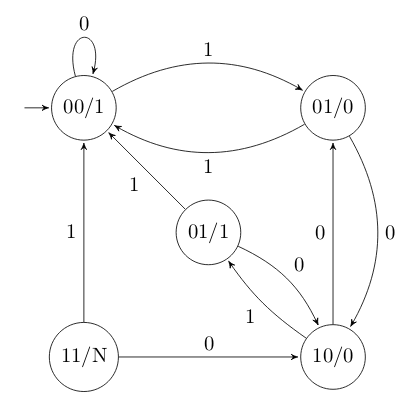
 

It is clear from FSM from state $00$ to reach state $01$ with output $1$ i.e, $01/1$ with need minimum length input 101

Minimum length of input $=$ length of $101$. That is 3.

Correct Answer: $A$

• edited by
35 35 votes
A = 0, B = 1, Output = 1 is given only by the second last transition in the table. So, we can go back from here.

Here, the previous state is A = 1, B = 0. So, see which state gives next state as this. (1 char is gone here)

The second and fourth transitions in the table gives this as next state. Previous state of second transition is  A = 0 and B = 1. Lets consider this first (2 chars gone).
The fifth transition gives A = 0 and B = 1 from A = 0, B = 0 which is our given initial state (3 chars). So, we needn't check any other possibility as 3 must be the minimum length of the input string.
• edited by
1 1 vote

Consider the below given FSM (represented as graph)


From the given FSM we can clearly see that, if we start from initial state (00) and follow the input “101” 

{state 00, 1} -> state “01” , output 0,
{state 01, 0} -> state “10” , output 0,
{state 10, 1} -> state “01” , output 1,
Hence it require an input string of minimum length 3, which will take the machine to the state A=0, B=1 with Output = 1.

0 0 votes
A simpler approach,

If we simply trace the table, then we can see this sequence will give the required output with input string length as 3.

present state = 00

00 (i/p = 1 , o/p = 0, A=0, B=0) → 01 (i/p = 0 , o/p = 0) → 10 (i/p = 1 , o/p = 1) → 01 .(A=0, B=1 , o/p = 1)

So input string is 101. Length = 3. Option (A).
Answer:
Position:
Show:

Related questions

45 45 votes
6 answers 6 answers
20.9k
20.9k views
Kathleen asked Oct 9, 2014
20,928 views
Consider the following state table for a sequential machine. The number of states in the minimized machine will be$$\begin{array}{|l|l|ll|}\hline \text{} & \text{} & \tex...
48 48 votes
5 answers 5 answers
17.2k
17.2k views
Kathleen asked Oct 8, 2014
17,205 views
A finite state machine with the following state table has a single input $x$ and a single out $z$.$$\begin{array}{|c|ll|}\hline\textbf{present state} & \qquad \textbf{nex...
78 78 votes
3 answers 3 answers
20.5k
20.5k views
Kathleen asked Oct 4, 2014
20,467 views
State True or False with one line explanationA FSM (Finite State Machine) can be designed to add two integers of any arbitrary length (arbitrary number of digits).
60 60 votes
6 answers 6 answers
34.9k
34.9k views
Kathleen asked Sep 22, 2014
34,888 views
What is the minimum number of gates required to implement the Boolean function $\text{(AB+C)}$ if we have to use only $2\text{-input NOR}$ gates?$2$$3$$4$$5$