12,094 views
63 63 votes

Let $F$ be the collection of all functions $f: \{1, 2, 3\} \to \{1, 2, 3\}$. If $f$ and $g \in F$, define an equivalence relation $\sim$ by $f\sim g$ if and only if $f(3) = g(3)$. 

  1. Find the number of equivalence classes defined by $\sim$. 
  2. Find the number of elements in each equivalence class. 

6 Answers

Best answer
59 59 votes
Total number of functions = $3 * 3 * 3 = 27$ as each of $1, 2$, and 3 has $3$ choice to map to.

Now, for the equivalence relation, we need the mapping of 3 to be fixed. i.e., two functions $f$ and $g$ are related if and only if $f(3) = g(3).$ So, with 3 -> 1, we can get 3 * 3 = 9 functions as 2 and 3 have 3 choices to map to each, and similarly 9 each for 3 -> 2 and 3 -> 3.

a. So, total number of equivalence classes $= 3$, one each for $3$ $->$ $1, 3$ $->$ $2$, and $3 -> 3$.

b. Number of elements (elements here are functions) in each equivalence class $= 9.$
edited by
37 37 votes

First, read the answer given by Arjun sir and then just see the table for the number of equivalence class and number of elements in each class.

S.no class1(3->1 fixed) class2(3->2 fixed) class3(3->3fixed)
1 {(1,1),(2,2),(3,1)} {(1,1),(2,2),(3,2)} {(1,1),(2,2),(3,3)}
2 {(1,1),(2,1),(3,1)} {(1,1),(2,1),(3,2)} {(1,1),(2,1),(3,3)}
3 {(1,1),(2,3),(3,1)} {(1,1),(2,3),(3,2)} {(1,1),(2,3),(3,3)}
4 {(1,2),(2,2),(3,1)} {(1,2),(2,2),(3,2)} {(1,2),(2,2),(3,3)}
5 {(1,2),(2,1),(3,1)} {(1,2),(2,1),(3,2)} {(1,2),(2,1),(3,3)}
6 {(1,2),(2,3),(3,1)} {(1,2),(2,3),(3,2)} {(1,2),(2,3),(3,3)}
7 {(1,3),(2,2),(3,1)} {(1,3),(2,2),(3,2)} {(1,3),(2,2),(3,3)}
8 {(1,3),(2,1),(3,1)} {(1,3),(2,1),(3,2)} {(1,3),(2,1),(3,3)}
9 {(1,3),(2,3),(3,1)} {(1,3),(2,3),(3,2)} {(1,3),(2,3),(3,3)}

So,we can clearly see that there are exactly 3 distinct equivalence class and no of elements in each equivalence class is 9.

The correct answer for (a) is 3 and for (b) is 9.

10 10 votes
Here given is the set of all the functions {1,2,3}→{1,2,3} => 27 functions

and the equivalence relation R saying that any 2 functions from above set will be related i.e., f R g , if f(3) = g(3).

Now, as a property of equivalence classes of elements, any 2 elements which are related, will fall in the same equivalence class.

So, all those functions which have f(3) = 3 will fall in 1 class, those with f(3) = 2 will fall in second, and f(3) = 1 in third.

Hence the 3 equivalence classes, and size of each is 3^2.
7 7 votes

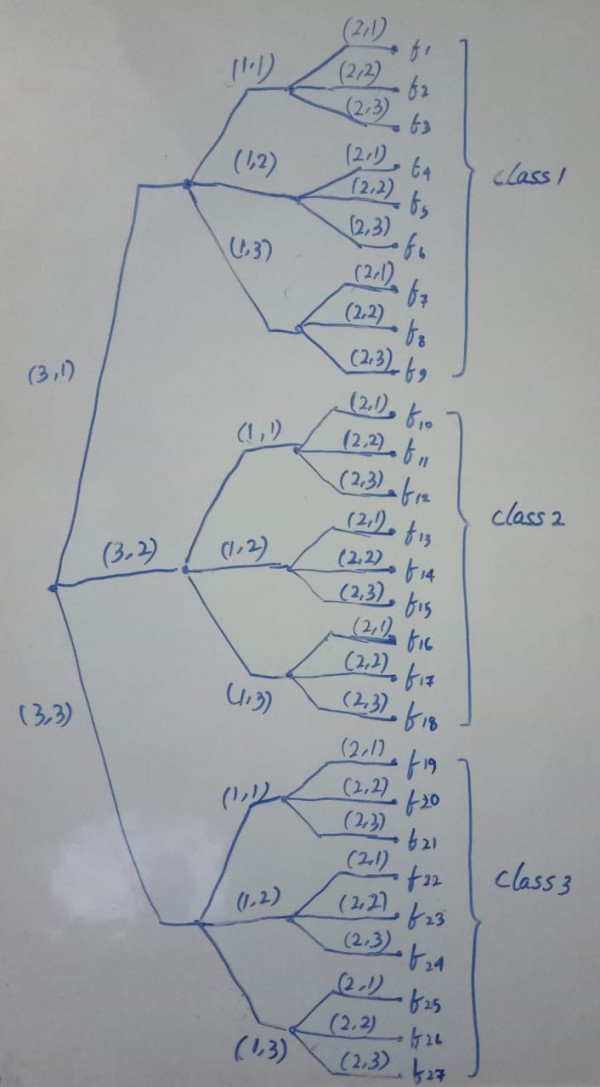
As given in the diagram, each branch represents a function in $F$. e.g. $f1 = \left \{ (3,1), (1,1), (2,1) \right \}$ forms a function.

Now, the the relation $\sim$ will be as follows- 

$\sim \ = \left \{ {\color {Red}{(f_1, f_1), (f_1, f_2), (f_1, f_3), \dots, (f_1, f_9), (f_2, f_1), (f_2, f_2), (f_2, f_3), \dots, (f_2, f_9), (f_3, f_1), (f_3, f_2), (f_3, f_3), \dots, (f_3, f_9), \dots, (f_9, f_1), (f_9, f_2), (f_9, f_3), \dots, (f_9, f_9),}} \\ {\color {Blue}{(f_{10}, f_{10}), (f_{10}, f_{11}), (f_{10}, f_{12}), \dots, (f_{10}, f_{18}), (f_{11}, f_{10}), (f_{11}, f_{11}), (f_{11}, f_{12}), \dots, (f_{11}, f_{18}), (f_{12}, f_{12}), (f_{12}, f_{11}), (f_{12}, f_{12}), \dots, (f_{12}, f_{18}), \dots, (f_{18}, f_{10}), (f_{18}, f_{11}), (f_{18}, f_{12}), \dots, (f_{18}, f_{18}),}} \\ {\color {Green}{(f_{19}, f_{19}), (f_{19}, f_{20}), (f_{19}, f_{21}), \dots, (f_{19}, f_{27}), (f_{20}, f_{19}), (f_{20}, f_{20}), (f_{20}, f_{21}), \dots, (f_{27}, f_{27}), (f_{21}, f_{21}), (f_{21}, f_{20}), (f_{21}, f_{21}), \dots, (f_{21}, f_{27}), \dots, (f_{27}, f_{19}), (f_{27}, f_{20}), (f_{27}, f_{21}), \dots, (f_{27}, f_{27})}} \right \}$

Therefore, there are 3 equivalence classes which are as follows-

  • Class 1 - $[f_1] = [f_2] = [f_3] = \dots = [f_9] = \left \{ f_1, f_2, f_3, \dots, f_9 \right \}$
  • Class 2 - $[f_{10}] = [f_{11}] = [f_{12}] = \dots = [f_{18}] = \left \{ f_{10}, f_{11}, f_{12}, \dots, f_{18} \right \}$
  • Class 3 - $[f_{19}] = [f_{20}] = [f_{21}] = \dots = [f_{27}] = \left \{ f_{19}, f_{20}, f_{21}, \dots, f_{27 }\right \}$

Therefore, we can see that there are 3 equivalence classes, each having 9 elements.

edited by
3 3 votes

Detailed Video Solution, with Complete Analysis: Video Solution with Complete Analysis (Click HERE)  

Two functions f and g  in F are said to be Equivalent if and only if f(3)=g(3).

For any function f in F, f(3) can be either 1 or 2 or 3.

When f(3) = 1, Number of such functions possible in F for which f(3) = 1, will be  3^2 = 9 and all these 9 functions for which f(3) = 1, Are Equivalent (according to the condition defined for Equivalence of functions) 

Similarly for, When f(3) = 2  and When f(3) = 3. 

So, there will be Three Equivalence Classes, One for when f(3) = 1, One for when f(3) = 2, and One for f(3) = 3.  And Each equivalence class will have 9 Elements(functions) each.

So, Answer for 

1. : number of equivalence classes defined by "∼"  = 3

2.:  number of elements in each equivalence class  = 9

edited by
2 2 votes

Functions from $\{1,2,3\}$ to $\{1,2,3\}$ and an Equivalence Relation

Let $F$ be the collection of all functions 
\[
F : \{1,2,3\} \to \{1,2,3\}.
\]

(i) Total number of functions

The domain of the functions has 3 elements: 1, 2, 3.  

The co-domain also has 3 elements: 1, 2, 3.  

Each element in the domain can be mapped to any element in the co-domain:  

- For 1, there are 3 choices.  

- For 2, there are 3 choices.  

- For 3, there are 3 choices.  

Multiplying these together gives the total number of functions:  
\[
|F| = 3 \times 3 \times 3 = 27
\]

So, there are 27 functions in $F$.

other way: 

The number of elements in the domain is $3$ and the number of elements in the co-domain is also $3$.  

The total number of functions from the domain to the co-domain is given by
\[
|F| = |\text{co-domain}|^{|\text{domain}|} = 3^3 = 27.
\]
Hence, there are $27$ functions in $F$.

(ii) Defining a relation on $F$

Define a relation $\sim$ on $F$ by:  
\[
f \sim g \iff f(3) = g(3)
\]

This means two functions are related if and only if their value at 3 is the same.  

Examples:  

-  If $f(3) = 3$ and $g(3) = 3$, then $f \sim g$.  

- If $f(3) = 1$ and $g(3) = 3$, then $f \not\sim g$.

(iii) Checking equivalence relation (RST) 

- Reflexive: $f(3) = f(3)$, so $f \sim f$.  

- Symmetric: If $f(3) = g(3)$, then $g(3) = f(3)$, so $f \sim g \implies g \sim f$.  

- Transitive: If $f(3) = g(3)$ and $g(3) = h(3)$, then $f(3) = h(3)$, so $f \sim g$ and $g \sim h \implies f \sim h$.

Thus, $\sim$ is an equivalence relation.

(iv) Equivalence classes

Equivalence classes are determined by the value of $f(3)$:  

- $f(3) = 1$ forms one class.  

- $f(3) = 2$ forms another class.  

- $f(3) = 3$ forms another class.  

Example: For $f(3) = 1$, $f(1)$ and $f(2)$ can each take any of 3 values.  

(v) Size of each equivalence class

For each fixed $f(3)$:  

- $f(1)$ has 3 choices.  

- $f(2)$ has 3 choices.  

Hence, size of each class:  
\[
3 \times 3 = 9
\]

(vi) Conclusion

- Number of equivalence classes: 3  

- Number of functions in each class: 9  
 

Position:
Show:

Related questions

51 51 votes
5 answers 5 answers
20.4k
20.4k views
Kathleen asked Oct 9, 2014
20,397 views
Let $R$ be a non-empty relation on a collection of sets defined by $_{A}R_ B$ if and only if $A \cap B = \phi$. Then, (pick the true statement)$A$ is reflexive and transi...
56 56 votes
10 answers 10 answers
16.4k
16.4k views
Kathleen asked Oct 9, 2014
16,402 views
Let $R$ denote the set of real numbers. Let $f:R\times R \rightarrow R \times R$ be a bijective function defined by $f(x,y) = (x+y, x-y)$. The inverse function of $f$ is ...
47 47 votes
11 answers 11 answers
16.0k
16.0k views
Kathleen asked Oct 9, 2014
16,000 views
Suppose $X$ and $Y$ are sets and $|X| \text{ and } |Y|$ are their respective cardinality. It is given that there are exactly $97$ functions from $X$ to $Y$. From this one...
62 62 votes
6 answers 6 answers
16.2k
16.2k views
Kathleen asked Oct 9, 2014
16,194 views
Which one of the following is false?The set of all bijective functions on a finite set forms a group under function compositionThe set $\{1, 2, \dots p-1\}$ forms a group...