$1st$ minimum will always at root of min heap. Hence, $0$ comparisons.
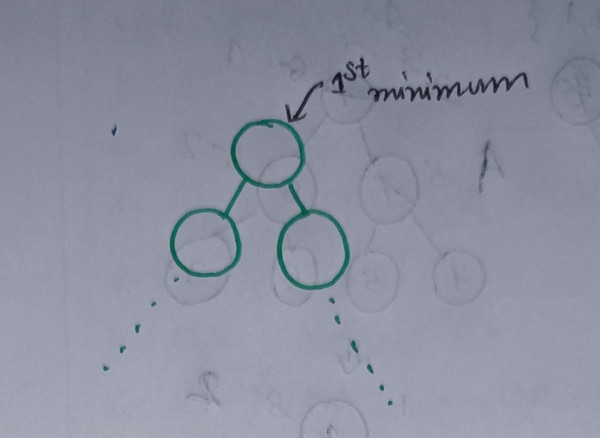
Now $2nd$ minimum can be child left child or right child of the root. Hence, $1$ comparison.
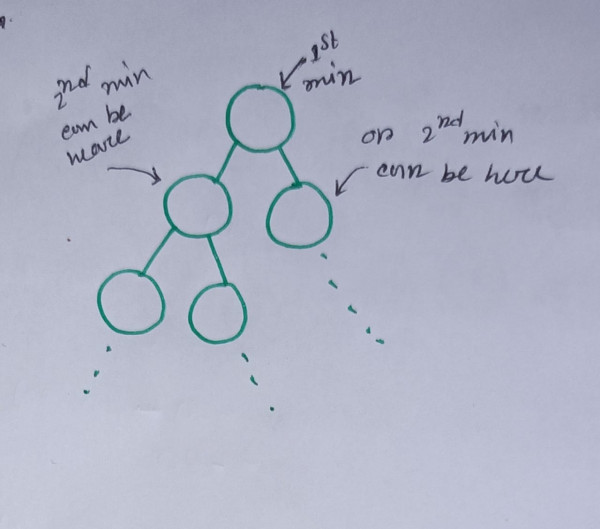
For the $3rd$ minimum we are assuming that $2nd$ min is the left child of root. So the $3rd$ minimum must be in the childs of $2nd$ min or right child of $1st$ min(root). Because if $3rd$ min is found other places than these nodes then min heap property will be violated (try yourself by some examples). So total comparison $2$.
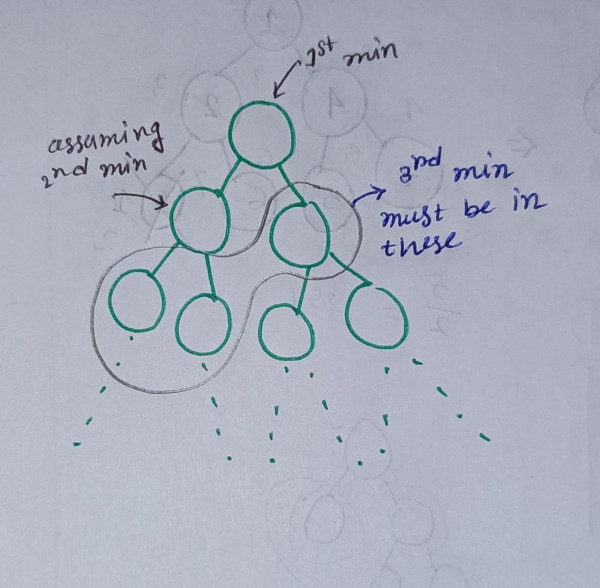
Now same way I am assuming the $3rd$ min is the left child of the $2nd$ min so the $4th$ min can be found in the the area in the picture below. So to find $4th$ min we have to compare $4$ nodes means $3$ comparisons.
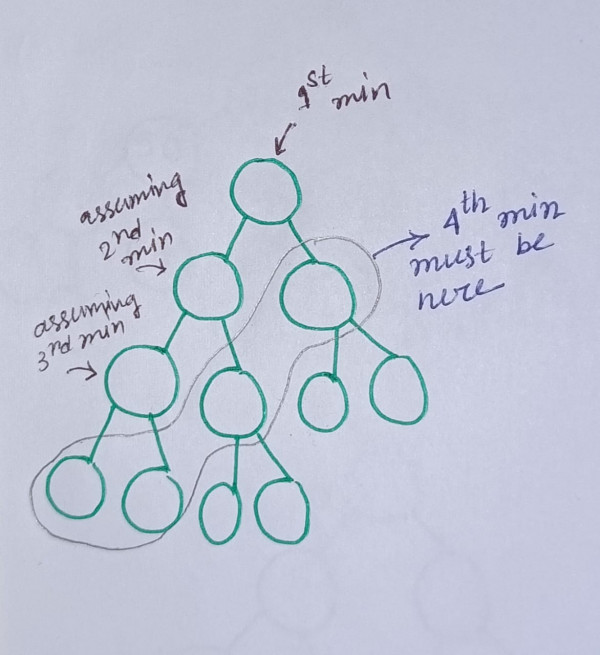
You can try the remaining yourself.
$1st \text{ min} \rightarrow \, 0 \text{ comparison}$
$2nd \text{ min} \rightarrow \, 1 \text{ comparison}$
$3rd \text{ min} \rightarrow \, 2 \text{ comparisons}$
$4th \text{ min} \rightarrow \, 3 \text{ comparisons}$
$5th \text{ min} \rightarrow \, 4 \text{ comparisons}$
$........................$
$........................$
$kth \text{ min} \rightarrow \, (k-1) \text{ comparisons}$
$\therefore$ To finnd $kth$ min we need $k(k-1)/2$ comp.
So to find $7th$ min we need $7(7-1)/2 = 21$ comp.
So time needed $\Theta(1)$.
Option: D

