693 views
1 1 vote
Consider the statement:

  x(ɑ - x) < y(ɑ-y) for all x,y with 0<x<y<1.

The statement is true

A. if and only if ɑ >= 2

B. if and only if ɑ > 2

C. If and only if ɑ <-1

D. for no values of ɑ

1 Answer

1 1 vote

Correct answer is option A.

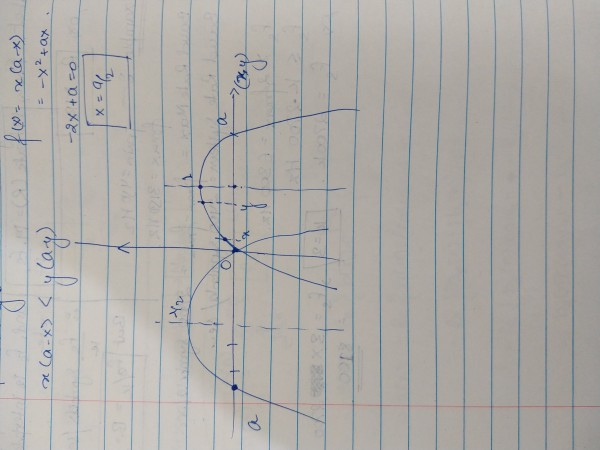
Function being evaluated is f(x) = x(a-x)

The graph will be a parabola opening downwards and cutting x axis at origin and a. 

If a >= 2, then the global Maxima point in the graph would be >=1 ( can be found by differentiating and equating to 0).

Now x,y are 2 points on x axis such that 0<x<y<1. Which means x and y are 2 values on the monotonous increasing part of the graph from 0 to 1 on x axis. 

In this part of x axis, since y > x always, therefore, x(a-x) < y(a-y) always.

I am providing the rough work I have done in order to solve this question. I drew 2 graphs one for positive a and one for negative a. I hope you will understand else please ask to clarify.
Position:
Show:

Related questions

0 0 votes
0 0 answers
752
752 views
Rojalin Baral asked Apr 20, 2018
752 views
1!+2!+3!+.............+99!=?
0 0 votes
0 0 answers
466
466 views
. asked Jul 19, 2016
466 views
0 0 votes
0 0 answers
511
511 views
. asked Jul 19, 2016
511 views
1 1 vote
1 1 answer
2.4k
2.4k views
. asked Jul 19, 2016
2,406 views
Which of the following numbers can be expressed as the sum of squares of two integers199519992003none of these