• edited by
46,658 views
125 125 votes

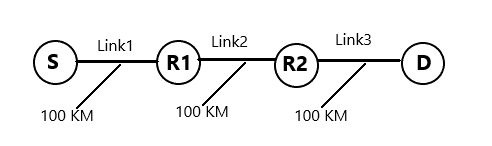
Consider a source computer $(S)$ transmitting a file of size $10^{6}$ bits to a destination computer $(D)$ over a network of two routers $(R_{1}\text{ and }R_{2})$ and three links $(L_{1},L_{2},\text{ and } L_{3})$. $L_{1}$ connects $S$ to $R_{1}$; $L_{2}$ connects $R_{1}$ to $R_{2}$; and $L_{3}$ connects $R_{2}$ to $D$. Let each link be of length $\text{100 km}$. Assume signals travel over each link at a speed of $10^{8}$ meters per second. Assume that the link bandwidth on each link is $\text{1 Mbps}$. Let the file be broken down into $1000$ packets each of size $1000$ bits. Find the total sum of transmission and propagation delays in transmitting the file from $S$ to $D$?

  1. $\text{1005 ms}$
  2. $\text{1010 ms}$
  3. $\text{3000 ms}$
  4. $\text{3003 ms}$

13 Answers

Best answer
175 175 votes
Routers are store and forward devices.

Propagation time $=\dfrac{100\;\text{km}}{10^8\;\text{m/s}}=1\;\text{milli second}$

Transmission time for a packet $=\dfrac{1000 \text{ bits}}{10^6 \text{ bits/sec}}=1\;\text{milli second}$

Packets will be forwarded in a pipelined manner after the first packet reaches the receiver, in every $1\;\text{ms}$ a new one arrives.

Now time taken by packet no $1$ to reach destination is :

$\text{1 ms ($T_x$ at sender) + 1 ms ($Tp$ from sender to R1) + 1ms  ($T_x$ at R1)}$

$\text{+ 1 ms($T_p$ from R1 to R2) + 1ms ($T_x$ at R2) + 1 ms ( $Tp$ from R2 to destination) = 6ms}$

So, time for packet, $1000=6\;\text{ms} + 999\;\text{ms} =1005\;\text{ms}$

Correct Answer: $A$
• edited by
164 164 votes
First all data needs to be transmitted from source and after all packets transmission from source, just focus on last packet jorney, and u will get it.

Transmission time for all packets from Source:= $\frac{10^6}{1\times 10^6}$ = 1 sec = $1000$ms.
(Now the last packet is our main focus, bcoz the moment last packet reaches, all previous are already reached to Destination)

Last packet time = $3\times \text{propagation time of link} + 2 \times \text{tranmsion time of router} $ (Transmission time for source is already included in above $1000$ msec)
= $(3 \times 1) + (2 \times 1)$ = 5ms

Total time= $1000+5 = 1005 \text{ms}$
33 33 votes

We have been given following info:
Signal Speed = 10^8 m/s

Bandwidth, BW = 1 Mbps = 10^6 bps

Propagation time, Tp = Link Distance/ Link Speed = (100x10^3)/(10^8) = 10^-3 sec = 1 ms.

[Propagation time is the time taken by packet to travel through the link]

Transmission time for 1 packet, Tt = Packet Size / BW = 1000 / 10^6 = 10^-3 sec = 1 ms.

[Transmission time is the time taken by source or router to process or put the data on Link]

Link filling time can be calculated as:

Pipeline Filling time
Time L1 R1 L2 R2 L3 D
t=0            
t=1 P1          
t=2 P2 P1        
t=3 P3 P2 P1      
t=4 P4 P3 P2 P1    
t=5 P5 P4 P3 P2 P1  
t=6 P6 P5 P4 P3 P2 P1

This way time taken by packet P1 to reach Destination (D) = 6 ms

Now, as you can see, at every ms, 1 packet will reach D.

Therefore, time taken for remaining 999 packets = 999 ms.

So, total time taken to transmit 1000 packets = 999 + 6 = 1005 ms.

Hence Option (A) is correct answer.


3 3 votes
S------R1--------R2--------D        here we will use the concept of packet switching first of all ,transmission time = L/B which is equal to 1mili second from S to D  total  Tt= s to R1(1milisec) +R1to R2(1milisec) +R2 to D(1milisec)=3milisec  ,now for remaining 999 packets it will be 999*1milisec=999milisec   (We send 1 packet and now we are sending remaining 999 packets)

so total Tt=3+999=1002

now the propogation delay Tp=D/V , here it is mentioned that (Let each link be of length 100 km) Total distance from S To D is  300km    so Tp=300*10^3/10^8=3milisec.

now the sum of Tt + Tp=1002+3=1005 milisecond. ANSWER IS A.
3 3 votes
A common doubt is why after the first packet arrives, every other packet arrives in 1 ms when clearly there is transmission and propagation delay (1ms + 1ms) to consider.

To see why this is so, consider a single link connecting the source to destination. Lets say there is 1ms transmission time and 1ms propagation time. So the first packet reaches the destination in 2 ms. But does the next packet require 2ms too?

No, because the sender has already finished transmission of the second packet (at t = 2ms) when the first packet reached the destination. Hence there is only the 1ms propagation delay to consider now.

Apply that same logic here. The first packet takes ms to reach the destination. But after that, the following packet needs only 1ms propagation delay to reach the destination. This gives our answer of 6ms + 999 ms = 1005ms.
Answer:
Position:
Show:

Related questions

107 107 votes
12 answers 12 answers
62.2k
62.2k views
Arjun asked Sep 29, 2014
62,163 views
Consider an instance of TCP’s Additive Increase Multiplicative Decrease (AIMD) algorithm where the window size at the start of the slow start phase is $2$ MSS and the thr...
108 108 votes
14 answers 14 answers
48.6k
48.6k views
gatecse asked Sep 26, 2014
48,604 views
An Internet Service Provider (ISP) has the following chunk of CIDR-based IP addresses available with it: $245.248.128.0/20$. The ISP wants to give half of this chunk of a...
67 67 votes
7 answers 7 answers
17.9k
17.9k views
go_editor asked Apr 21, 2016
17,867 views
Consider the following C code segment.int a, b, c = 0; void prtFun(void); main() { static int a = 1; /* Line 1 */ prtFun(); a += 1; prtFun(); printf(“ \n %d %d ”, a, b); ...
69 69 votes
5 answers 5 answers
23.4k
23.4k views
go_editor asked Apr 21, 2016
23,407 views
Consider the following relations $A, B$ and $C:$ $$\overset{\textbf{A}}{\begin{array}{|c|c|c|}\hline\\\textbf{Id}& \textbf{Name}& \textbf{Age} \\\hline12& \text{A...