• edited by
40,957 views
150 150 votes

Which one of the choices given below would be printed when the following program is executed ?

#include <stdio.h>
struct test {
               int i;
               char *c;
}st[] = {5, "become", 4, "better", 6, "jungle", 8, "ancestor", 7, "brother"};
main ()
{ 
    struct test *p = st;
    p += 1;
    ++p -> c;
    printf("%s,", p++ -> c);
    printf("%c,", *++p -> c);
    printf("%d,", p[0].i);
    printf("%s \n", p -> c);
}
  1. $\text{jungle, n, 8, nclastor}$
  2. $\text{etter, u, 6, ungle}$
  3. $\text{cetter, k, 6, jungle}$
  4. $\text{etter, u, 8, ncestor}$

7 Answers

Best answer
488 488 votes

code :

#include <stdio.h>

struct test {
    int i;
    char *c;
}st[] = {5, "become", 4, "better", 6, "jungle", 8, "ancestor", 7, "brother"};

int main () { 
    //printf("size = %d\n",sizeof(struct test) );
    struct test *p = st;
    p += 1;
    ++p->c; // ++(p->c)
    printf("%s,", p++->c); // (p++)->c 
    printf("%c,", *++p->c); // *(++(p->c))
    printf("%d,", p[0].i);
    printf("%s \n", p->c);
}

We will assume few things:

  • Size of integer $4$ Bytes.
  • Size of a pointer $4$ Bytes.

Neglecting any alignment issues with the storage of this structure we will have $8$ Bytes per structure. 

And one precedence rule we need to use:


Initial situation :
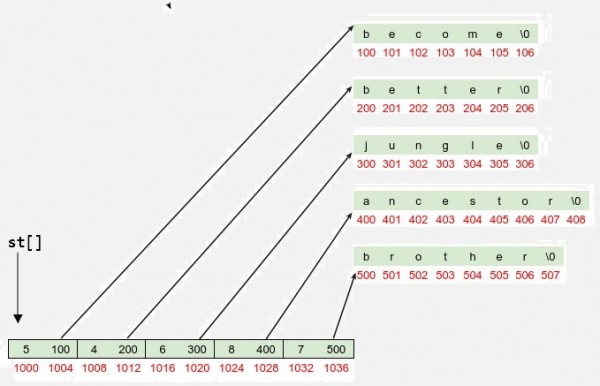

struct test *p = st;


p += 1;

We know that if ptr is a pointer then,  ptr + x = ptr + x*sizeof(*ptr);


++p->c;


printf("%s,", p++->c);         // (p++)->c
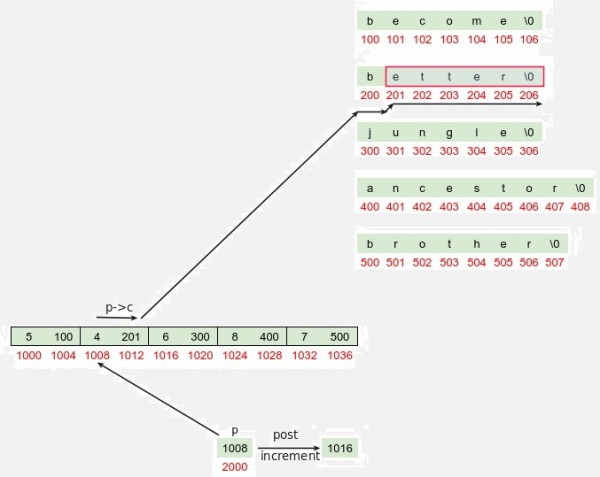

printf("%c,", *++p->c);     // *(++(p->c))
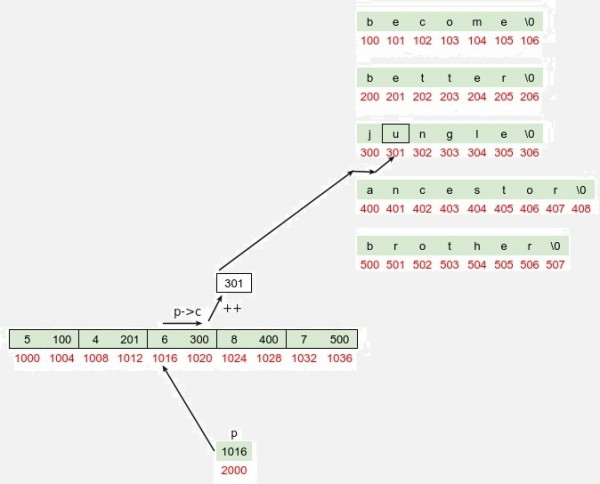

printf("%d,", p[0].i);


printf("%s \n", p->c);
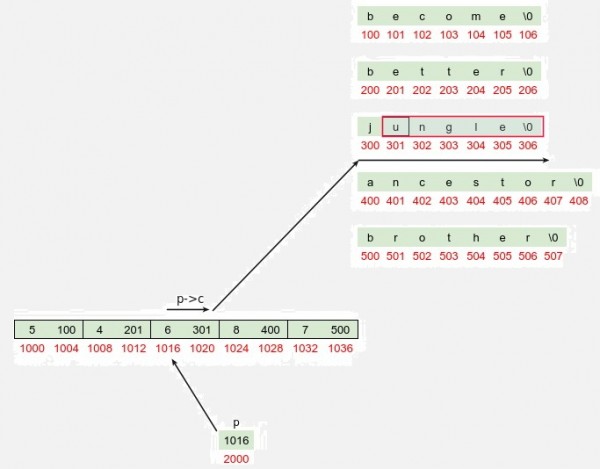
Correct Answer: $B$

• edited by
83 83 votes
#include <stdio.h>
struct test {
               int i;
               char *c;
}st[] = {5, "become", 4, "better", 6, "jungle", 8, "ancestor", 7, "brother"};
main ()
{ 
    struct test *p = st;
    

p += 1;

++p -> c;
printf("%s,", p++ -> c);
    

Prints value and  increments the pointer. Pointing ti the next structure

printf("%c,", *++p -> c); // *(++( p->c ))

printf("%d,", p[0].i); //Prints the integer value associated with struct pointed by p

printf("%s \n", p -> c); //Prints the character string pointed by p

PS : Thank you @monanshi for the explanation

24 24 votes

Answer is B )

Run The code.

http://codepad.org/WmSREd4G

For extra inofrmation =>

++p -> c will become ++(p -> c)
p++ -> c will become (p++) -> c
 *++p -> c will become => *++(p->c)

Reference-> C Puzzle Book

17 17 votes

I am getting B.


1.#include <stdio.h>
2.struct test {
3.               int i;
4.              char *c;
5.}st[] = {5, "become", 4, "better", 6, "jungle", 8, "ancestor", 7, "brother"};
6.main ()
7.{ 
8.   struct test *p = st;
9.    p += 1;
10.    ++p -> c;
11.    printf("%s,", p++ -> c);
12.    printf("%c,", *++p -> c);
13.    printf("%d,", p[0].i);
14.    printf("%s \n", p -> c);
15.}


Line 8 => Initially p is pointing to st, i.e, first element of st which is {5, "become"}
Line 9 => Now p is pointing to {4, "better"}
Line 10=> ++(p->c) since -> has higher precedence. So, p->c points to 'e' of 'better'
Line 11=> prints 'etter' and p now points to {6, "jungle"}
Line 12=> *++(p->c) since -> has higher precedence. prints 'u'
Line 13=> p->i, which is 6 so prints '6'
Line 14=> prints 'ungle' since p is pointing to 'u'.

So, output is "etter, u, 6, ungle" that is B.

4 4 votes

Ans is option b

3 3 votes
answer is :

option B

etter,u,6,ungle
Answer:
Position:
Show:

Related questions

101 101 votes
8 answers 8 answers
24.4k
24.4k views
Ishrat Jahan asked Oct 31, 2014
24,440 views
Which one of the choices given below would be printed when the following program is executed? #include <stdio.h int a1[] = {6, 7, 8, 18, 34, 67}; int a2[] = {23, 5...
117 117 votes
10 answers 10 answers
41.8k
41.8k views
Ishrat Jahan asked Oct 31, 2014
41,777 views
Which one of the choices given below would be printed when the following program is executed?#include <stdio.h void swap (int *x, int *y) { static int *temp; temp = x; x ...
51 51 votes
3 answers 3 answers
16.2k
16.2k views
Ishrat Jahan asked Nov 2, 2014
16,194 views
Consider the following C program:#include <stdio.h typedef struct { char *a; char *b; } t; void f1 (t s); void f2 (t *p); main() { static t s = {"A", "B"}; printf ("%s %s...
89 89 votes
11 answers 11 answers
38.3k
38.3k views
gatecse asked Feb 14, 2018
38,256 views
Consider the following C program:#include<stdio.h struct Ournode{ char x, y, z; }; int main() { struct Ournode p={'1', '0', 'a'+2}; struct Ournode *q=&p; printf("%c, %c",...