edited by
38,225 views
90 90 votes
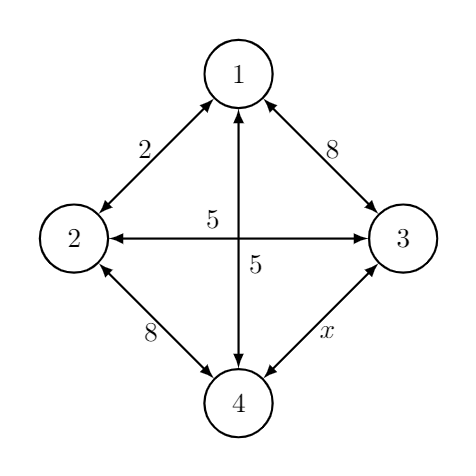
Consider the weighted undirected graph with $4$ vertices, where the weight of edge $\{i,j\}$ is given by the entry $W_{ij}$ in the matrix $W$.

 W=$\begin{bmatrix} 0&2 &8 &5 \\ 2&0 &5 &8 \\ 8&5 &0 &x \\ 5& 8 &x &0 \end{bmatrix}$

The largest possible integer value of $x$, for which at least one shortest path between some pair of vertices will contain the edge with weight $x$ is ___________.

10 Answers

Best answer
120 120 votes

Let us list down the shortest edge between each pair of vertices $x,y$ in the graph

$$\begin{array}{|c|c|c|}\hline \textbf{x} & \textbf{y} & \textbf{shortest path from x to  y} \\\hline  \text{1} & \text{2} & \text{2} \\\hline   \text{1} & \text{3} & \text{there is a direct path from 1 to 3 of weight 8.We can also choose to go}\\ && \text{ via node 4 with total path weight $5+x.$ if $5+x<8(x<3)$ then shortest}\\&&\text{path is $5+x$ otherwise shortest path is the weight of the direct path}\\ && \text{which is 8} \\\hline  \text{1} & \text{4} & \text{5} \\\hline \text{2} & \text{3} & \text{5} \\\hline  \text{2} & \text{4} & \text{there is a direct path from 2 to 4 of weight 8. We can also choose to go}\\ && \text{via node 3 with total path weight}{ 5+x}\text{. If }{ 5+x<8(x<3)}\text{ the shortest}\\ && \text{path is 5+x. otherwise shortest path is the weight of the direct path}\\ && \text{which is 8} \\\hline  \text{3} & \text{4} & \text{We can chose to go through the direct path of weight x or via nodes 2, 1 }\\ && \text{to node 4 with weight } 5+2+5=12 \text{. If }{x<12}\text{ then we will chose x to be the shortest}\\&& \text{path otherwise $12$ is the shortest path} \ \\\hline \end{array}$$ 

  • Case 1: Let us say $x < 3$. Say $x = 2$.

When we put $x = 2$ the above table is modified as

$$\begin{array}{|c|c|c|}\hline \textbf{x} & \textbf{y} & \textbf{shortest path from x to y} \\\hline  \text{1} & \text{2} & \text{2} \\\hline   \text{1} & \text{3} & \text{7} \\\hline  \text{1} & \text{4} & \text{5} \\\hline \text{2} & \text{3} & \text{5} \\\hline  \text{2} & \text{4} & \text{7} \\\hline  \text{3} & \text{4} & \text{2 // Note that the shortest path between nodes $3$ and $4$ is $x =2$} \\\hline  \end{array}$$

  • Case 2: $3 \leq x < 13$. Let's say $x = 12$. The table is now modified as

$$\begin{array}{|c|c|c|}\hline \textbf{x} & \textbf{y} & \textbf{shortest path from x to y} \\\hline  \text{1} & \text{2} & \text{2} \\\hline   \text{1} & \text{3} & \text{8} \\\hline  \text{1} & \text{4} & \text{5} \\\hline \text{2} & \text{3} & \text{5} \\\hline  \text{2} & \text{4} & \text{8} \\\hline  \text{3} & \text{4} & \text{12 // Note that the shortest path between nodes $3$ and $4$ is $x=12$} \\ && \text{and one of the shortest path is the direct edge $x$} \\ \hline   \end{array}$$ 

Now the question asks you to find the largest possible integer value of $x$ such that shortest path between at least one pair of nodes in the graph is equal to $x.$ For values $x = 2,3,4,\ldots,12$ the shortest path between node $3$ and $4$ is equal to $x$.

The largest among this is $x = 12$. So the answer is $12$

PS:  If the question is modified as "The largest possible integer value of $x$, for which the shortest path between some pair of vertices is guaranteed to contain the edge with weight $x$ is"
then the answer will be $11.$

Correct Answer: $12.$

edited by
65 65 votes
Answer is $x=12$.  Here, when we read the last sentence of the question, i.e the largest possible integer value of $x$. when $x=11$, the shortest path is an edge with weight $x$ only. But when $x=12$, there are $2$ shortest paths, and we can say that the edge with weight $x$ is also the shortest path. At least $1$ shortest path contain edge $x$. So the answer will be $12$.
edited by
32 32 votes

ans is simple....if we want to get shortest path between c and d without x its 8+5=13 so to get the shortest path between c and d we can include weight 12 which is maximum...correct me if i am wrong...

23 23 votes

For the people who didn't understand the above explanations ( although going through them again will make it clear) I'm putting in simple words.

We're asked to find value$'x'$ so that shortest path between any two vertices contains the edge with cost $'x'.$

Let us verify for the vertices $3$ and $4.$

To travel from vertex $3$ to vertex $4$: we have $3$ possible paths.

$1.$ Path $3-1-4$ with cost$=8+5=13$

$2.$ Path $3-2-4$ with cost$=5+8=13$

$3.$ Edge $3-4$ with cost$=x$

So, for the edge $3-4$ to be the shortest path between vertices $3$ and $4$, $x$ should be less than $13$.

Since we're asked to find the maximum value for $x$, the answer is $12.$

edited by
8 8 votes

x =12.

if you take x =13, then there is path between C and D -> C-B-A-D which is 12, so x=13 will not consider as shortest path.

now if you take 11, then it will be shortest path but not largest, when x=12 then then there is two path between D and C which is 12. Both are the shortest path. So, it is shortest path which is largest.

5 5 votes

Draw the graph by considering the values given in the matrix as:


We have to find the largest possible integer value of x for which at least one shortest path between some pair of vertices will contain the edge (3,2) that is x.

After we draw the graph we can find it in couple of seconds like this-

For Smallest possible integer value of x:

From vertex 3: The weight of the edge (3,1) is 8. We can reach vertex 1 via vertex 2 in less than 8 cost i.e  if value of x is 0,1 or 2 than cost can be 5 (i.e 0+5), 6(i.e 1+5) or 7(i.e 2+5) respectively.

For Largest possible integer value of x:

From vertex 3 We can reach vertex 2 via vertex 0 in 13 cost. But we can reach vertex 2 via edge (3,2) if value of x is 12 (i.e largest possible).

Hence, Largest possible value of x =12.

Answer:
Position:
Show:

Related questions

80 80 votes
6 answers 6 answers
26.6k
26.6k views
Sandeep Singh asked Feb 12, 2016
26,559 views
An operator delete$(i)$ for a binary heap data structure is to be designed to delete the item in the $i$-th node. Assume that the heap is implemented in an array and $i$...
79 79 votes
5 answers 5 answers
35.3k
35.3k views
Sandeep Singh asked Feb 12, 2016
35,327 views
A queue is implemented using an array such that ENQUEUE and DEQUEUE operations are performed efficiently. Which one of the following statements is CORRECT ($n$ refers to ...
239 239 votes
14 answers 14 answers
61.2k
61.2k views
Sandeep Singh asked Feb 12, 2016
61,160 views
Let $Q$ denote a queue containing sixteen numbers and $S$ be an empty stack. $Head(Q)$ returns the element at the head of the queue $Q$ without removing it from $Q$. Simi...
117 117 votes
21 answers 21 answers
55.4k
55.4k views
Sandeep Singh asked Feb 12, 2016
55,406 views
Let $G$ be a complete undirected graph on $4$ vertices, having $6$ edges with weights being $1, 2, 3, 4, 5,$ and $6$. The maximum possible weight that a minimum weight s...