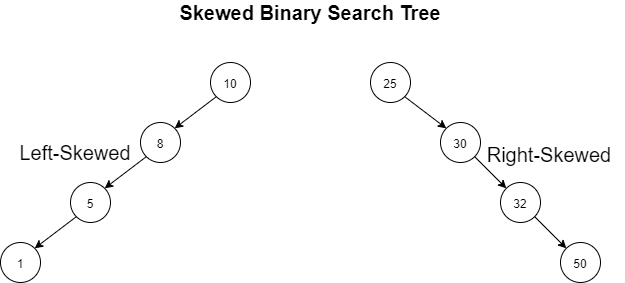
(A) In the worst case, a BST can be completely skewed (e.g., when elements are inserted in sorted order), forming a linear chain of $n$ nodes. The path from the root to the deepest leaf then contains $n - 1$ edges, which is the maximum possible for any binary tree with $n$ nodes. Hence, this statement is true.
(B) By the defining property of a BST, all keys in the left subtree of a node are less than the node’s key, and all keys in the right subtree are greater. An inorder traversal (left → root → right) recursively visits keys in increasing order, and thus always yields a sorted sequence. This holds for every BST, so the statement is true.
(C) The worst-case time complexity for searching in a BST is $O(n)$, which occurs when the tree is degenerate (height $n - 1$). The bound $O(\log n)$ applies only to balanced BSTs, not to arbitrary BSTs. Therefore, this statement is false.
(D) A Min-Heap requires that each node’s key be less than or equal to its children’s keys. A BST imposes an ordering between left/right subtrees but does not enforce a parent-child magnitude constraint compatible with the heap property. For example, the BST with root $2$, left child $1$, and right child $3$ violates the Min-Heap condition (since $1 < 2$). Thus, this statement is false.
Final Answer: (A), (B)

