• edited by
18,697 views
62 62 votes

Consider a $TCP$ connection in a state where there are no outstanding $ACK$s. The sender sends two segments back to back. The sequence numbers of the first and second segments are $230$ and $290$ respectively. The first segment was lost, but the second segment was received correctly by the receiver. Let $X$ be the amount of data carried in the first segment (in bytes), and $Y$ be the $ACK$ number sent by the receiver.
The values of $X$ and $Y$ (in that order) are

  1. $60$ and $290$
  2. $230$ and $291$
  3. $60$ and $231$
  4. $60$ and $230$

7 Answers

Best answer
50 50 votes

Answer is D.

Because it is said that the connection is $TCP$ and the sender has sent first two segments which is clear from the text "The sequence numbers of the first and second segments are $230$ and $290$ respectively." That means there must be $3$ Way handshaking that has been done before the connection has been established and when sender has sent SYN packet then reciever must have ACKED him with next packet .In response to it reciever only recieved only $1$ packet so he will come to know that 1$^{st}$ packet has been lost and again he will send ACK for lost packet 

• edited by
1 flag:
✌ Low quality (leo_t “question does not say about the syn segment if it had syn it would have been specified in the question, the correct reason is tcp uses cumulative ack .”)
14 14 votes
ans d)
1 flag:
✌ Low quality (solar_raven “Answer not elaborated on.”)
10 10 votes

The following picture makes it explain clearly
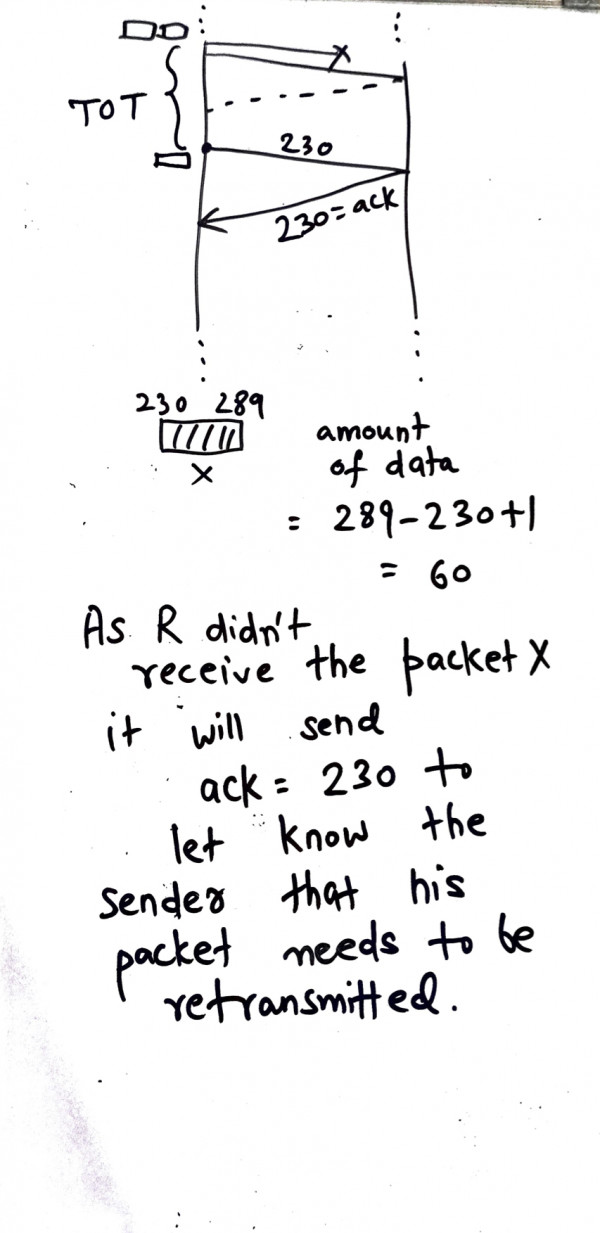
TOT is the time out timer which will retransmit the given packet if its ack is not receieved to us within its timeframe.

So now Receiver has received the packet of 290 header. It will then wait for sometime for A to retransmit the packet and meanwhile when it received packet of 230 header it will be then sending it the acknowledge of 230.

4 4 votes
  1. TCP Sequence Numbers: TCP sequence numbers count bytes, not segments. So if the first segment starts at 230 and the second starts at 290, then the first segment must have carried 290 − 230 = 60 bytes. ✅ So, X = 60

  2. Receiver Behavior: TCP is cumulative ACK based. If the first segment is lost, the receiver will not acknowledge the second segment—even if it arrives—because it’s out-of-order. The receiver will still expect the first byte it hasn’t received, which is sequence number 230. ✅ So, Y = 230

✅ Final Answer:

X = 60, Y = 230 → Option D

Answer:
Position:
Show:

Related questions

54 54 votes
7 answers 7 answers
19.3k
19.3k views
Ishrat Jahan asked Oct 29, 2014
19,284 views
Consider the following statements about the timeout value used in TCP.The timeout value is set to the RTT (Round Trip Time) measured during TCP connection establishment f...
1 1 vote
2 2 answers
4.0k
4.0k views
Ishrat Jahan asked Oct 30, 2014
3,968 views
Consider a token ring topology with N stations (numbered 1 to N) running token ring protocol where the stations are equally spaced. When a station gets the token it is al...
3 3 votes
2 answers 2 answers
5.3k
5.3k views
Ishrat Jahan asked Oct 30, 2014
5,313 views
Consider a token ring topology with N stations (numbered 1 to N) running token ring protocol where the stations are equally spaced. When a station gets the token it is al...
28 28 votes
3 answers 3 answers
17.6k
17.6k views
Ishrat Jahan asked Oct 30, 2014
17,605 views
You are given the following four bytes : $$\begin{array}{| c | c | c | c |} \hline 10100011 & 00110111 & 11101001 & 10101011 \\\hline \end{array}$$ Which of the fol...