edited by
28,260 views
39 39 votes

In the waveform (a) given below, a bit stream is encoded by Manchester encoding scheme. The same bit stream is encoded in a different coding scheme in wave form (b). The bit stream and the coding scheme are

  1. $1000010111$ and Differential Manchester respectively
  2. $0111101000$ and Differential Manchester respectively
  3. $1000010111$ and Integral Manchester respectively
  4. $0111101000$ and Integral Manchester respectively

7 Answers

39 39 votes

THE AMBIGUOUS QUESTION WITHOUT ANY STANDARD MENTION !!

BOTH $A$ and $B$ is correct , it is just the convention which determine the correct answer.

see this from IIT KGP, they follow IEEE standard - 

http://nptel.ac.in/courses/Webcourse-contents/IIT%20Kharagpur/Computer%20networks/pdf/M2L4.pdf or archive

and this one from IITB , they follow G E Thomas version -- 

https://www.cse.iitb.ac.in/synerg/lib/exe/fetch.php?media=public:courses:cs348-spring08:slides:topic03-phy-encoding.pdf

As per $\text{IEEE}$ B is correct

As per $\text{G E Thomas}$ A is correct.

As we ususally follow IEEE thus B is correct 

edited by
11 11 votes

In this question option  A) is as per G E Thomas standard and option B)  is as per IEEE standard . 

Here Manchester code 1000010111  is based on  G E Thomas  standard and 0111101000 is based on  IEEE standard. Both are correct as there is no standard explicitly mentioned !!

But we generally follow IEEE standard thats why as per IEEE B is correct answer in this question .

Along with that, Rule for differential Manchester is, Let me post snap From Data Communication book ,Forouzen ->
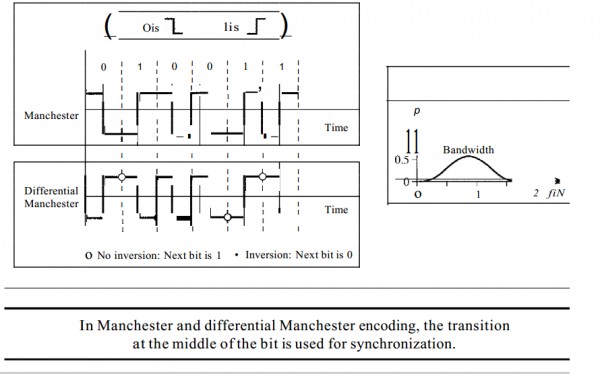
Looking at this image, It is clear this book follow IEEE standard ,  And so this is differential Manchester.

AFAIK, there is no term as Integral Manchester, It was just put there for more confusion.

3 3 votes

Manchester encoding(Used in Ethernet) -->

https://www.youtube.com/watch?v=XKtxxZ327UM. But There are two way to do Manchester encoding. 

  1. In IEEE 802.3 '1' is represented by low-to-high and '0' represented by high-to-low.
  2. G.E. Thomas' convention   '1' by high-to-low transition     and   '0' is expressed by a low-to-high transition.

Differential Manchester(Used in Token Ring) -->

https://www.youtube.com/watch?v=du_boiwX1yU

Now in mentioned question G.E. Thomas' convention is used and answer is (A) Part. 

Please notify if anything is not proper. Thank you @Shivam Chauhan ji and @Tuhin Dutta ji. 

PS:  Some additional info -->

Manchester encoding not only transmitting the actual data, but also the clock (meta data) due to its self clocking characteristic.

https://stackoverflow.com/questions/25834577/why-in-manchester-encoding-the-bit-rate-is-half-of-the-baud-rate

In both Manchester and Differential Manchester encoding scheme -->
Baud Rate =2*Bit Rate

edited by
3 3 votes

according to G.E. Thomas' convention   '1' by high-to-low transition     and   '0' is expressed by a low-to-high transition 

In IEEE 802.3 '1' is represented by low-to-high and '0' represented by high-to-low 

From waveform (a) we got the bit sequence 

1.  1000010111 (G.E. THOMAS)

2.  0111101000 (IEEE 802.3)

As the standard is not given so we have to draw waveform of differential manchester encoding using both standard. And try to match with the given waveform (b)

 In Differential manchester if next bit is 0 then there is a Inversion  , if next bit is 1 then there is NO inversion

Only the the waveform following the standard G.E. Thomas is matching with the given waveform

So the correct option is  (A) .

reshown by
0 0 votes

Correct answer A

If u take option A bit stream and make dman it will match 

If u take option B bit stream u will get this:-

0 0 votes

Answer: (A)

Explanation: In simple language, Manchester encoding has +A to -A transition for the clock cycle for which bit is ‘1’ and transition from -A to +A for the cycle when bit is ‘0’ (A is the amplitude).

kriti_9

kriti_10

The amplitudes are bipolar in Differential manchester encoding same as manchester encoding just that it toggles at ‘1’. When bit is ‘1’ we get transition from +A to -A and it remains the same until next ‘1’ arrives. The output changes to opposite transition (-A to +A) when next ‘1’ arrives.
The second encoding resembles the differential manchester code for the given number.

Answer:
Position:
Show:

Related questions

63 63 votes
9 answers 9 answers
18.5k
18.5k views
Ishrat Jahan asked Oct 30, 2014
18,503 views
A broadcast channel has $10$ nodes and total capacity of $10$ Mbps. It uses polling for medium access. Once a node finishes transmission, there is a polling delay of $80$...
78 78 votes
5 answers 5 answers
23.8k
23.8k views
Ishrat Jahan asked Oct 30, 2014
23,791 views
Let us consider a statistical time division multiplexing of packets. The number of sources is $10$. In a time unit, a source transmits a packet of $1000$ bits. The number...
18 18 votes
4 answers 4 answers
15.4k
15.4k views
Kathleen asked Sep 21, 2014
15,387 views
In Ethernet when Manchester encoding is used, the bit rate is:Half the baud rateTwice the baud rateSame as the baud rateNone of the above
1 1 vote
2 2 answers
3.9k
3.9k views
Ishrat Jahan asked Oct 30, 2014
3,886 views
Consider a token ring topology with N stations (numbered 1 to N) running token ring protocol where the stations are equally spaced. When a station gets the token it is al...