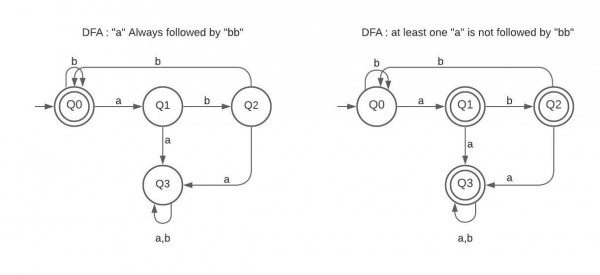
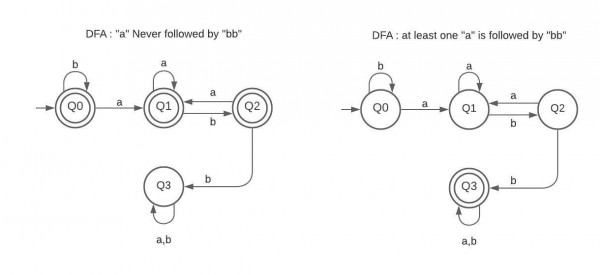
You have a small misunderstanding.
~$(\forall x,P(x)) \neq (\forall x,$~$P(x)) $ instead
- ~$(\forall x,P(x)) = (\exists x,$~$P(x)) $
- $(\forall x,$~$P(x)) =$~$(\exists x,$$P(x)) $
Above 3 lines in English :
Complement of $a$ always followed by $bb$ is not $a$ never followed by $bb$ instead
- Complement of $a$ always followed by $bb$ is at least one $a$ is not followed by $bb$.
- $a$ never followed by $bb$ is complement of at least one $a$ is followed by $bb$.
Now about the DFA,
Let $D$ is DFA for language $L$ then $\bar D$ is DFA for language $\bar L$ where
$\bar D$ is obtained my making all Final states in $D$ Non Final states and all Non Final states in $D$ becomes Final states in $\bar D$ ( Reversing the DFA as you said )
This sould have resolved any confusion, still here are all four diagrams for reference :