retagged by
23,272 views
53 53 votes

Consider a network with three routers $\text{P, Q, R}$ shown in the figure below. All the links have cost of unity.

The routers exchange distance vector routing information and have converged on the routing tables, after which the link $\text{Q-R}$ fails. Assume that $\text{P}$ and $\text{Q}$ send out routing updates at random times, each at the same average rate. The probability of a routing loop formation (rounded off to one decimal place) between $\text{P}$ and $\text{Q},$ leading to count-to-infinity problem, is _______________.

5 Answers

Best answer
85 85 votes

Answer : $0.5$

Once Q-R fails then Q will immediately update its distance to R to $\infty$. But P will still be having some finite value (which is 2).

Now it depends on P and Q, who is sending distance vector first.

if Q sends then system becomes stable immediately but if P sends first then it will be count to infinity. Please understand that count to infinity is not some wrong thing, it is just it takes some time to stable.

Since it is given in question that both have same average rate hence probability is also $\frac{1}{2}$ that P sends first than Q. Hence the answer.

But we can calculate answer more mathematically considering that time is continuous variable.
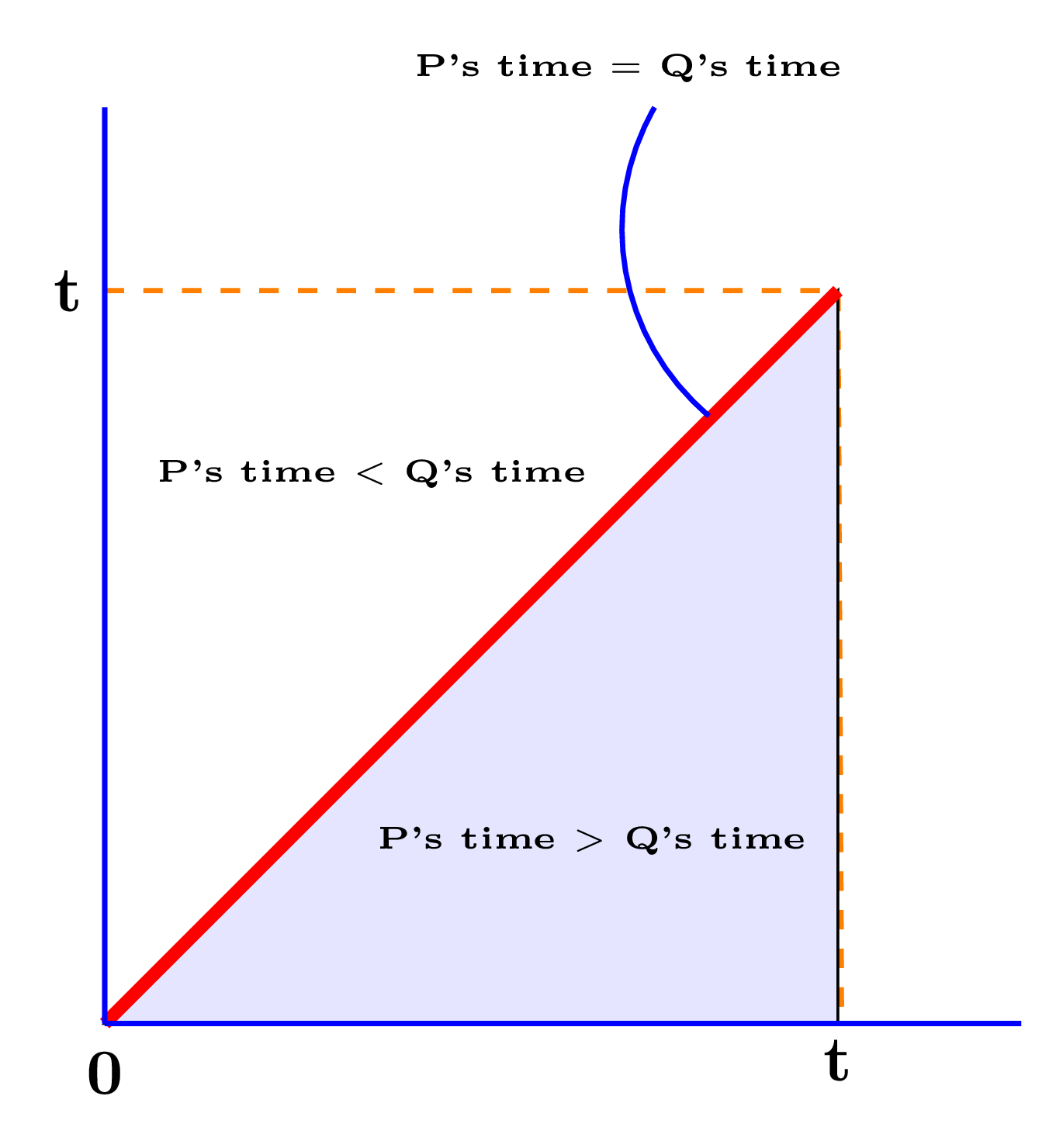
We are interested in probability represented by the shaded area,  

which will be  = $\frac{\text{Area of Tringle}}{\text{Area of Square}} = \frac{\frac{1}{2}t^2}{t^2} = \frac{1}{2}$

$\text{Method 2 OPTIONAL}$

Let $X$ and $Y$ be uniform random variables in $[0,t]$ representing time for $P$ and $Q$ respectively.
We need to find $P(X<Y) = ?.$

$P(X<Y) = P(X \leq Y) = P(X \leq k)$ (Let $Y =k$).

$ P(X \leq k) =$ Can you continue from here ?.

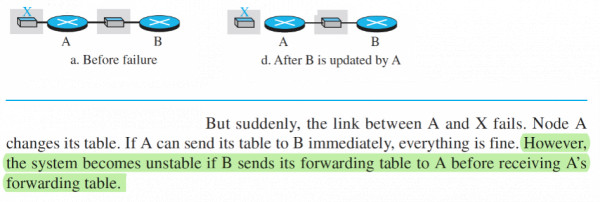
Also refer Forouzan snapshot of count to infinity
 

Similar question – [page 22, 23] https://www.classes.cs.uchicago.edu/archive/2003/winter/54001-1/data/hw2sol.pdf 

edited by
14 14 votes
0.5 because it depends on Node Q or node P sharing information first.

If node Q shares it first there is no looping.

If node P does it there will definitely be a count to infinity problem.
9 9 votes

.

0 0 votes

🔁 What causes the loop?

After Q–R fails:

  • Q no longer has a valid route to R.

  • But if P hasn’t yet learned about the failure, it might still advertise a route to R via Q.

  • Q, seeing P’s route to R, might believe R is reachable via P.

  • This mutual misbelief causes a routing loop between P and Q, leading to the count-to-infinity problem.

🎲 Probability of Loop Formation

The key is timing:

  • For a loop to form, Q must send its update before P does, so P still thinks R is reachable via Q.

  • Since both send updates randomly at the same average rate, the probability that Q sends first is: 0.5

Answer:
Position:
Show:

Related questions

1 1 vote
0 0 answers
237
237 views
Shubham Sharma 2 asked Sep 9, 2025
237 views
Which of the following statement/s is/are NOT CORRECT?$\textrm{OSPF}$ is based on distance-vector routing protocol.Both link-state and distance-vector routing are based o...
2 2 votes
0 0 answers
668
668 views
eggs asked Feb 27, 2025
668 views
Consider the routing protocols given in List I and the names given in List II: $$ \begin{array}{|c|c|} \hline \textbf{List I} & \textbf{List II} \\ \hline (\text{i}) \ \ ...