Let the number of tosses be $Y$. Since we are tossing a fair coin until the first head appears, $Y$ follows a geometric distribution with probability $p = \frac{1}{2}$.
The probability of getting the first head on the $k$-th toss is:
$$ P(Y = k) = \left(\frac{1}{2}\right)^{k-1} \left(\frac{1}{2}\right) = \left(\frac{1}{2}\right)^k $$
We want to find $P(\text{Odd} \mid \text{Not a multiple of 3})$, which is defined as:
$$ P(\text{Odd} \mid \text{Not a multiple of 3}) = \frac{P(\text{Odd} \text{ and } \text{Not a multiple of 3})}{P(\text{Not a multiple of 3})} $$
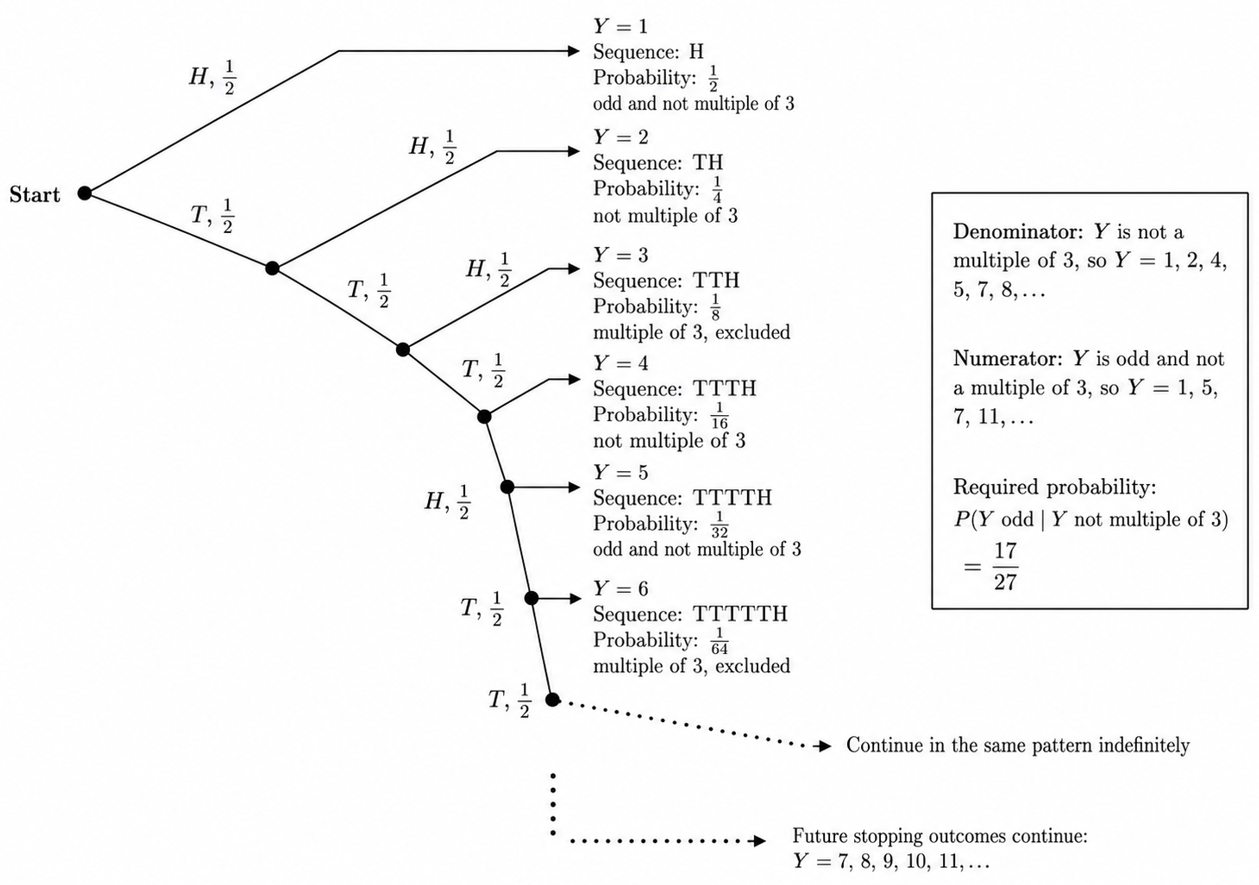
Finding the probability that $Y$ is not a multiple of $\mathbf{3}$ :
It is easier to calculate the complement: the probability that $Y$ is a multiple of $3$ ($Y \in \{3, 6, 9, 12, \dots\}$).
This is an infinite geometric series:
$$ P(Y \text{ is a multiple of 3}) = P(Y=3) + P(Y=6) + P(Y=9) + \dots $$
$$ = \left(\frac{1}{2}\right)^3 + \left(\frac{1}{2}\right)^6 + \left(\frac{1}{2}\right)^9 + \dots $$
The first term is $a = \frac{1}{8}$ and the common ratio is $r = \frac{1}{8}$. The sum is:
$$ \frac{a}{1 - r} = \frac{\frac{1}{8}}{1 - \frac{1}{8}} = \frac{\frac{1}{8}}{\frac{7}{8}} = \frac{1}{7} $$
Therefore, the probability that $Y$ is not a multiple of $3$ is:
$$ P(\text{Not a multiple of 3}) = 1 - \frac{1}{7} = \frac{6}{7} $$
Finding the probability that $Y$ is odd AND not a multiple of $\mathbf{3}$
The set of odd numbers that are not multiples of $3$ is $\{1, 5, 7, 11, 13, 17, \dots\}$.
These numbers can be split into two sequences:
Sequence 1: $1, 7, 13, 19, \dots$ (which can be written as $6k+1$ for $k=0, 1, 2, \dots$)
Sequence 2: $5, 11, 17, 23, \dots$ (which can be written as $6k+5$ for $k=0, 1, 2, \dots$)
Let's find the sum of probabilities for each sequence.
For Sequence 1 ($1, 7, 13, \dots$):
$$ P(Y \in \{1, 7, 13, \dots\}) = \left(\frac{1}{2}\right)^1 + \left(\frac{1}{2}\right)^7 + \left(\frac{1}{2}\right)^{13} + \dots $$
This is a geometric series with first term $a = \frac{1}{2}$ and common ratio $r = \left(\frac{1}{2}\right)^6 = \frac{1}{64}$.
$$ \text{Sum}_1 = \frac{\frac{1}{2}}{1 - \frac{1}{64}} = \frac{\frac{1}{2}}{\frac{63}{64}} = \frac{1}{2} \cdot \frac{64}{63} = \frac{32}{63} $$
For Sequence 2 ($5, 11, 17, \dots$):
$$ P(Y \in \{5, 11, 17, \dots\}) = \left(\frac{1}{2}\right)^5 + \left(\frac{1}{2}\right)^{11} + \left(\frac{1}{2}\right)^{17} + \dots $$
This is a geometric series with first term $a = \frac{1}{32}$ and common ratio $r = \frac{1}{64}$.
$$ \text{Sum}_2 = \frac{\frac{1}{32}}{1 - \frac{1}{64}} = \frac{\frac{1}{32}}{\frac{63}{64}} = \frac{1}{32} \cdot \frac{64}{63} = \frac{2}{63} $$
Adding these together gives the intersection probability:
$$ P(\text{Odd} \text{ and } \text{Not a multiple of 3}) = \frac{32}{63} + \frac{2}{63} = \frac{34}{63} $$
Now,
$$ P(\text{Odd} \mid \text{Not a multiple of 3}) = \frac{P(\text{Odd} \text{ and } \text{Not a multiple of 3})}{P(\text{Not a multiple of 3})} = \frac{\frac{34}{63}}{\frac{6}{7}} = \boxed{\frac{17}{27}} $$
