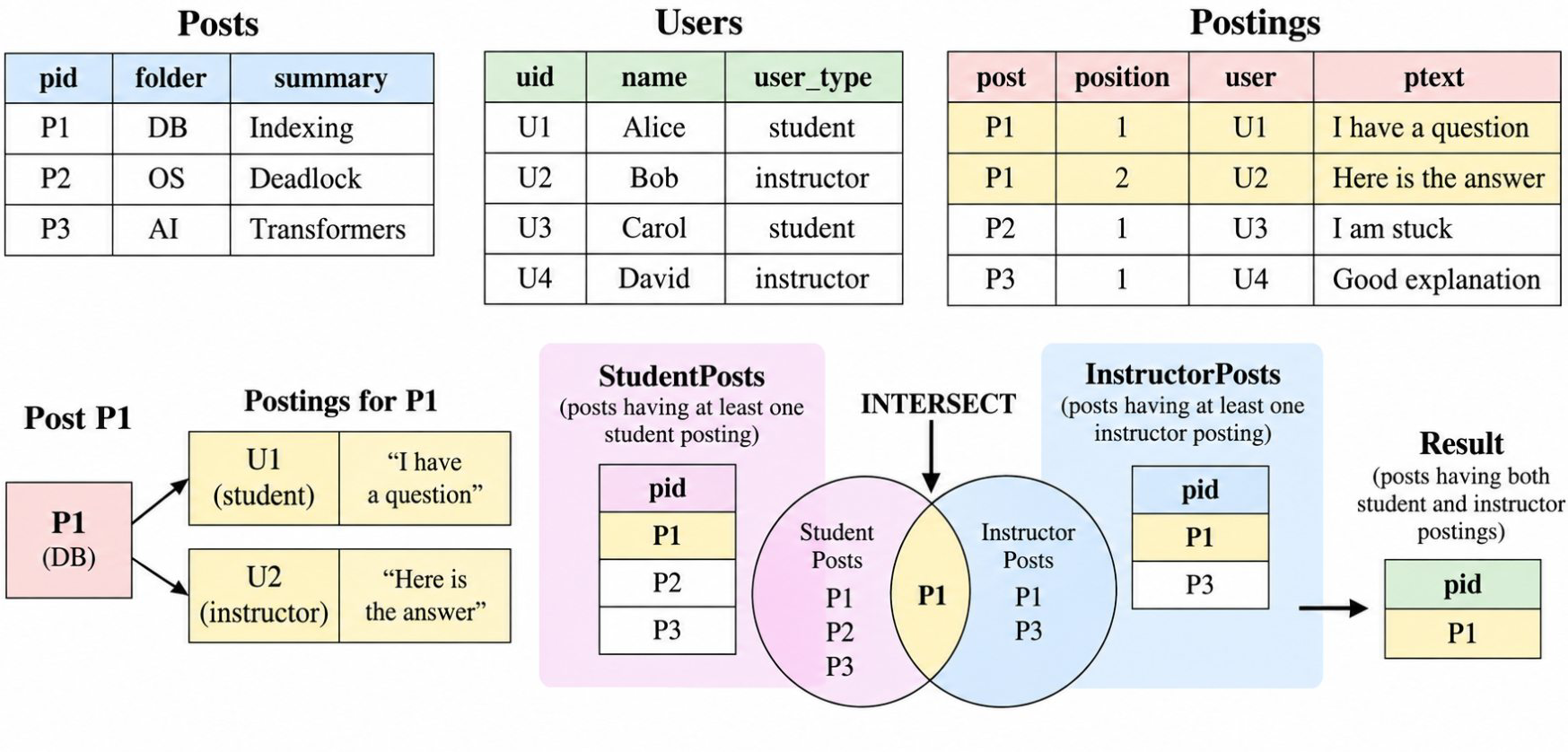
Suppose post $\mathrm{P1}$ has:
$\begin{array}{|c|c|} \hline \mathrm{Post} & \mathrm{User\ Type} \\ \hline \mathrm{P1} & \mathrm{student} \\ \mathrm{P1} & \mathrm{instructor} \\ \hline \end{array}$
The requirement is satisfied because two different tuples together establish the condition.
Why A works
The first query produces posts having student postings: $\mathrm{P1}$
The second produces posts having instructor postings: $\mathrm{P1}$
Their intersection contains posts appearing in both sets:
$\mathrm{StudentPosts\ INTERSECT\ InstructorPosts}$
Therefore $\mathrm{P1}$ survives.
Why C is wrong
$\mathrm{student\ OR\ instructor}$
means the post has at least one of the two types.
A post containing only a student would incorrectly qualify.
Why D is wrong
The predicate:
$\mathrm{user\_type}=\text{'student'}$
$\mathrm{AND}$
$\mathrm{user\_type}=\text{'instructor'}$
is evaluated on one joined tuple at a time.
A single $\mathrm{user\_type}$ value cannot simultaneously be both strings, so the result is empty.
Why B is wrong
$\mathrm{StudentPosts\ EXCEPT\ InstructorPosts}$
returns posts having student postings but not instructor postings, which is the opposite of the required both condition.
Hence,
Answer : $\boxed{\mathrm{A}}$
