105 views
0 0 votes

The database contains:

$\mathrm{Users}(\mathrm{uid},\mathrm{name},\mathrm{dob},\mathrm{user\_type})$

$\mathrm{Posts}(\mathrm{pid},\mathrm{folder},\mathrm{summary})$

$\mathrm{Folders}(\mathrm{fid},\mathrm{fname})$

$\mathrm{Postings}(\mathrm{post},\mathrm{position},\mathrm{user},\mathrm{ptext})$

The requirement is:

Return posts having both a student posting and an instructor posting.

Which query strategy or strategies satisfy the requirement

  1. (SELECT P.pid, P.folder, P.summary
     FROM Posts AS P
     INNER JOIN Postings AS Ping ON P.pid = Ping.post
     INNER JOIN Users AS U ON Ping.user = U.uid
     WHERE U.user_type = 'student')
    INTERSECT
    (SELECT P.pid, P.folder, P.summary
     FROM Posts AS P
     INNER JOIN Postings AS Ping ON P.pid = Ping.post
     INNER JOIN Users AS U ON Ping.user = U.uid
     WHERE U.user_type = 'instructor');

     
  2. (SELECT P.pid, P.folder, P.summary
     FROM Posts AS P
     INNER JOIN Postings AS Ping ON P.pid = Ping.post
     INNER JOIN Users AS U ON Ping.user = U.uid
     WHERE U.user_type = 'student')
    EXCEPT
    (SELECT P.pid, P.folder, P.summary
     FROM Posts AS P
     INNER JOIN Postings AS Ping ON P.pid = Ping.post
     INNER JOIN Users AS U ON Ping.user = U.uid
     WHERE U.user_type = 'instructor');

     
  3. (SELECT P.pid, P.folder, P.summary
     FROM Posts AS P
     INNER JOIN Postings AS Ping ON P.pid = Ping.post
     INNER JOIN Users AS U ON Ping.user = U.uid
     WHERE U.user_type = 'student'
     OR U.user_type = 'instructor');

     
  4. (SELECT P.pid, P.folder, P.summary
     FROM Posts AS P
     INNER JOIN Postings AS Ping ON P.pid = Ping.post
     INNER JOIN Users AS U ON Ping.user = U.uid
     WHERE U.user_type = 'student'
     AND U.user_type = 'instructor');
    

1 Answer

1 1 vote


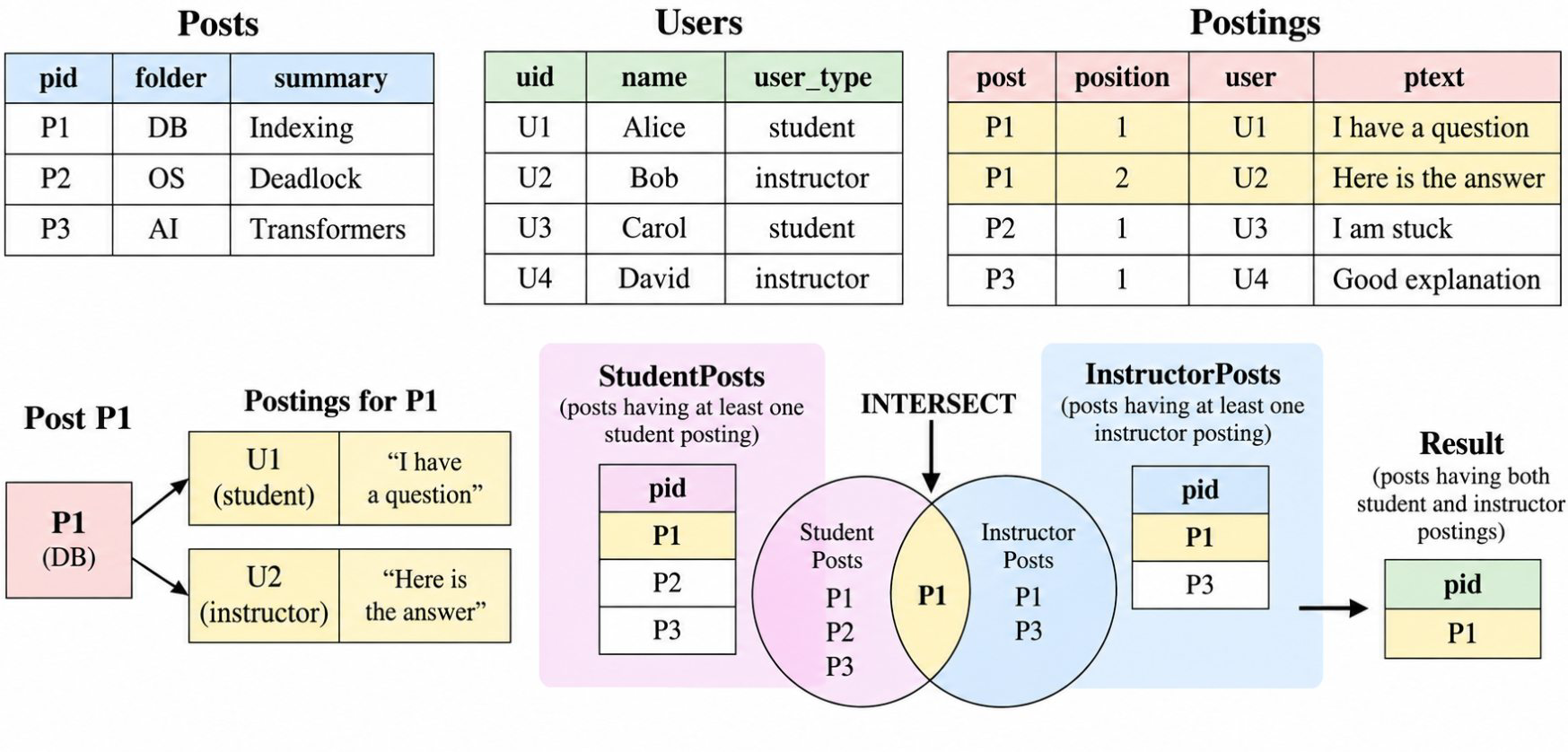
Suppose post $\mathrm{P1}$ has:

$\begin{array}{|c|c|} \hline \mathrm{Post} & \mathrm{User\ Type} \\ \hline \mathrm{P1} & \mathrm{student} \\ \mathrm{P1} & \mathrm{instructor} \\ \hline \end{array}$

The requirement is satisfied because two different tuples together establish the condition.

Why A works

The first query produces posts having student postings: $\mathrm{P1}$

The second produces posts having instructor postings: $\mathrm{P1}$

Their intersection contains posts appearing in both sets:

$\mathrm{StudentPosts\ INTERSECT\ InstructorPosts}$

Therefore $\mathrm{P1}$ survives.

Why C is wrong

$\mathrm{student\ OR\ instructor}$

means the post has at least one of the two types.

A post containing only a student would incorrectly qualify.

Why D is wrong

The predicate:

$\mathrm{user\_type}=\text{'student'}$

$\mathrm{AND}$

$\mathrm{user\_type}=\text{'instructor'}$

is evaluated on one joined tuple at a time.

A single $\mathrm{user\_type}$ value cannot simultaneously be both strings, so the result is empty.

Why B is wrong

$\mathrm{StudentPosts\ EXCEPT\ InstructorPosts}$

returns posts having student postings but not instructor postings, which is the opposite of the required both condition.

Hence,

Answer : $\boxed{\mathrm{A}}$

Answer:
Position:
Show:

Related questions

3 3 votes
1 1 answer
124
124 views
GO Classes asked Sep 30
124 views
The Adjacency List table stores the data for the tree structure shown below. Which SQL keyword should be inserted at $\mathbf{[a]}$ to retrieve the leaf nodes of the tree...
1 1 vote
1 1 answer
94
94 views
GO Classes asked Sep 30
94 views
Consider:SQL Statement $\mathbf{1}$$\mathrm{SELECT\ *}$ $\mathrm{FROM\ R}$ $\mathrm{UNION}$ $\mathrm{SELECT\ *}$ $\mathrm{FROM\ R}$;SQL Statement $\mathbf{2}$$\mathrm{SEL...
1 1 vote
1 1 answer
102
102 views
GO Classes asked Sep 30
102 views
Consider the following $\mathrm{Product}$ table:$$\begin{array}{|c|c|c|c|} \hline \mathrm{ProductID} & \mathrm{Product} & \mathrm{SupplierID} & \mathrm{UnitPrice} \\ \hli...
1 1 vote
1 1 answer
106
106 views
GO Classes asked Sep 30
106 views
Let $\mathrm{R}$ and $\mathrm{S}$ be relations.For which of the following relational operations is it not necessary that $\mathrm{R}$ and $\mathrm{S}$ be union-compatible...