edited by
46,425 views
115 115 votes

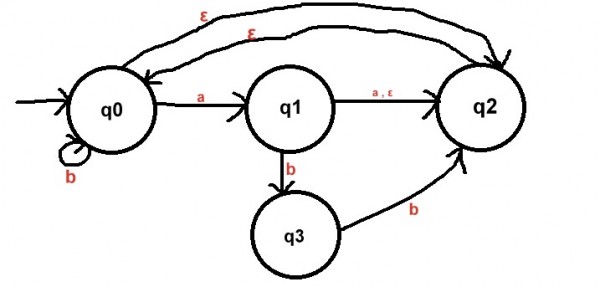
Let $\delta$ denote the transition function and $\widehat{\delta}$ denote the extended transition function of the $\epsilon$-NFA whose transition table is given below:
$$\begin{array}{|c|c|c|c|}\hline \delta  &  \text{$\epsilon$} & \text{$a$} & \text{$b$} \\\hline  \llap{$\to$}{ q_0}  &  \text{$\{q_2\}$} & \text{$\{q_1\}$} & \text{$\{q_0\}$} \\\hline  \text{$q_1$}  &  \text{$\{q_2\}$} & \text{$\{q_2\}$} & \text{$\{q_3\}$} \\\hline \text{$q_2$}  &  \text{$\{q_0\}$} & \text{$\emptyset$} & \text{$\emptyset$} \\\hline \quad\text{$q_3$}\quad  &  \text{$\emptyset$} & \text{$\emptyset$} & \text{$\{q_2\}$} \\\hline \end{array}$$
Then $\widehat{\delta}(q_2, aba)$ is

  1. $\emptyset$
  2. $\{q_0, q_1, q_3\}$
  3. $\{q_0, q_1, q_2\}$
  4. $\{q_0, q_2, q_3 \}$

13 Answers

Best answer
183 183 votes

Starting state $: q_2$ and input string is "$aba$"

  • $\text{Step 1: }$ Find Epsilon closure of $q_2 = \{q_2,q_0\}$
  • $\text{Step 2: }$ Find transitions on $a:$     
    • $q_0\to q_1$
    • $q_2 \to \emptyset$
  • $\text{Step 3: }$ Find epsilon closure of $q_1= \{q_1,q_2,q_0\}$
  • $\text{Step 4: }$ Find transitions on $b:$
    • $q_1\to q_3$
    • $q_0\to q_0$
    • $q_2\to \emptyset$
  • $\text{Step 5:}$ Find epsilon closure of $q_0=\{q_0,q_2\}$ UNION  epsilon closure of $q_3=\{q_3\}, = \{q_0,q_2,q_3\}$
  • $\text{Step 6:}$ Find transitions on $a:$
    • $q_0 \to q_1$
    • $q_2 \to \emptyset$
    • $q_3 \to \emptyset$
  • $\text{Step 7:}$ Find epsilon closure of $q_1: \{q_1,q_0,q_2\}$

Therefore answer is C.

edited by
42 42 votes

the transition is nothing but (((Q2,a),b),a)

now applying Q2,a we go to Q0 but as  lamda transition is there so it will also go to Q2

so now {(Q0,Q2),b} = Q0,Q2

now{(Q0,,Q2),a}=Q0,Q1,Q2

so C should be correct answer here

33 33 votes

C is the answer.

edited by
21 21 votes

so ans is C

6 6 votes

On giving the input "aba" to q2, where can we possibly go?

The answer will not contain q3, because to reach q3, we need to end with b strictly. But our input "aba" ends with a. B and C eliminated.

Answer is not ϕ because with just epsilon transitions, we'll go to at least some state from q2. Option A eliminated.

Hence, Option C

Solved it under a minute!


The proper solution would be to check where can we go from q2 on aba manually, as other answers show.


Answer:
Position:
Show:

Related questions

65 65 votes
10 answers 10 answers
28.3k
28.3k views
Madhav asked Feb 14, 2017
28,323 views
The minimum possible number of states of a deterministic finite automaton that accepts the regular language $L$ = {$w_{1}aw_{2}$ | $w_{1},w_{2}$ $\in$ $\left \{ a,b \righ...
50 50 votes
6 answers 6 answers
14.9k
14.9k views
Madhav asked Feb 14, 2017
14,897 views
Consider the following languages.$L_1 = \{a^p \mid p \text{ is a prime number} \}$$L_2 = \{ a^nb^mc^{2m} \mid n \geq 0, m \geq 0 \}$$L_3 = \{a^n b^n c^{2n} \mid n \geq 0 ...
42 42 votes
5 answers 5 answers
14.2k
14.2k views
Madhav asked Feb 14, 2017
14,202 views
Let $L(R)$ be the language represented by regular expression $R$. Let $L(G)$ be the language generated by a context free grammar $G$. Let $L(M)$ be the language accepted ...
48 48 votes
13 answers 13 answers
24.9k
24.9k views
khushtak asked Feb 14, 2017
24,881 views
Identify the language generated by the following grammar, where $S$ is the start variable.$ S \rightarrow XY$$ X \rightarrow aX \mid a$$ Y \rightarrow aYb \mid \epsilon$$...