• edited by
81,343 views
138 138 votes
The minimum number of comparisons required to find the minimum and the maximum of $100$ numbers is ________

19 Answers

Best answer
102 102 votes

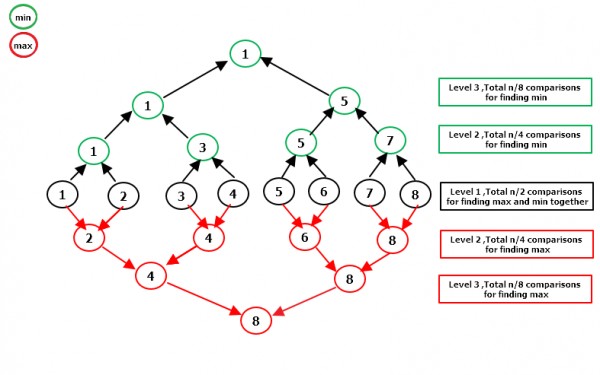
NOTE: At level 1 in $\frac{n}{2}$ comparisons we are finding Both MINIMUM as well as MAXIMUM for level 2.  

Let's see for minimum,

At level 1 :$\frac{n}{2}$ comparisons

At level 2 : $\frac{n}{2^2}$ comparisons

At level 3 : $\frac{n}{2^3}$ comparisons

so on.... 

At level logn : $\frac{n}{2^{logn}}$ comparisons

So, Total number of comparisons will be 

$\frac{n}{2}$ +  $\frac{n}{2^2}$ +  $\frac{n}{2^3}$ + .....+ $\frac{n}{2^{logn}}$

$\Rightarrow$ n ($\frac{1}{2}$ +  $\frac{1}{2^2}$ +  $\frac{1}{2^3}$ + .....+ $\frac{1}{2^{logn}}$ )   [apply Sum of G.P]

$\Rightarrow$ $n\frac{1}{2}(\frac{1-(\frac{1}{2})^{logn}}{1-\frac{1}{2}})$

$\Rightarrow$ $n\frac{1}{2}(\frac{1-(2)^{-logn}}{\frac{1}{2}})$

$\Rightarrow$  $n(1-\frac{1}{n})$

$\Rightarrow$  $n-1$

So,total comparisons required to find minimum of n element is n-1 comparisons.

similarly for Max n-1 comparisons required.

So total comparisons for both min and max will be

$2(n-1) - \frac{n}{2}$     $\Rightarrow$ $\frac{3n}{2}-2$   

 [ $\frac{n}{2}$ is reduced because at Level 1 we have taken $\frac{n}{2}$ for both while min and max calculation ]

coming to question n = 100,

total comparisons $\Rightarrow$ $\frac{3 * 100}{2}-2 =  148$   


• selected by
173 173 votes

We can solve this question by using Tournament Method Technique -

1. To find the smallest element in the array will take $n-1$ comparisons $= 99.$

2. To find the largest element - 

  1. After the first round of Tournament , there will be exactly $n/2$ numbers $= 50$ that will loose the round.
  2. So, the biggest looser (the largest number) should be among these $50$ loosers.To find the largest number will take $n/2 - 1$ comparisons $= 49.$

Total $99+49 = 148.$

76 76 votes

Ans: minimum number of comparison require to find minimum and maximum is: Approach is divide and conquer ....

  T(n) = T(floor(n/2)) + T(ceil(n/2)) + 2 
  T(2) = 1 // if two element then compare both and return max and min
  T(1) = 0 // if one element then return both max and min same

  If $n$ is a power of $2$, then we can write $T(n)$ as:

   T(n) = 2T(n/2) + 2 

  After solving above recursion, we get

  T(n)  = (3/2)n - 2 

 Thus, the approach does $(3/2)n -2$ comparisons if $n$ is a power of $2$. And it does more than $(3/2)n -2$ comparisons if $n$ is not a power of $2$.

So, here in this case put $n=100$ and we will get $(3/2)(100) - 2 = 148$ comparison .....

• edited by
48 48 votes

Tournament Method Technique(Easy Method by example)

For example we have 8 elements [1,4,5,8,3,2,7,9]

Step-1: Make buckets of 2 elements:: (1,4) (5,8) (3,2) (7,9)

Step-2: Find Minimum and Maximum from this buckets, and make both side expanding tree like this,

Step-3: So you need (n-1) comparisons for finding either minimum or maximum

Step-4: first (n/2) comparisons only needed once.

Step-5: So total(Minimum+Maximum): 2*(n-1)-(n/2) = [3*(n/2)-2]

12 12 votes

The answer is based on computing minimum and maximum in pairs of two 

say number of elements in even and array is 

   5 1 2 5 6 8 9  10

than code goes as follows

fun(){

   int mn,mx;

   if(arr[0]>arr[1]){  mn=arr[1];mx=arr[0];} // 1 comparison for 2 elements

   else{ mx=arr[1];mn=arr[0]; }

   for(int i=2;i<n;i=i+2){ // picking every  pair of element

       // we will calculate the minimum and maximum of this pair and then compare with global minimum and maximum hence total of 3 comparisons for a pair

      int t_mn,int t_mx; 

       if(arr[i]>arr[i+1]){ t_mn=arr[i+1]; t_mx=arr[i];} // 1st comparison 

     else {  t_mn=arr[i]; t_mx=arr[i+1];}

   if(mx>t_mx) mx=t_mx; // 2nd comparions

   if(mn<t_mx) mn=t_mx; // 3rd comparioson

}

cout << mx << " " <<  mn << endl;

return 0;

}

hence if n is number of elements

  than comparisons=1+((n-2)/2)*3

hence in n=100 ans=148                     

similarly in odd number of elements 1st element will be max as well as min

  hence comparisons=((n-1)/2)*3

refer to CLRS book

9 9 votes
Algorithm for finding minimum and maximum:

If n is odd then initialize min and max as first element.
If n is even then initialize min and max as minimum and maximum of the first two elements
respectively.
For rest of the elements, pick them in pairs and compare their
maximum and minimum with max and min respectively.

this is  same as the tournament method .


So when n is odd, number of comparisons = 3*(n-1)/2
when n is even, number of comparisons = [3*(n)/2] - 2 = 3*50-2 = 148.
Answer:
Position:
Show:

Related questions

79 79 votes
11 answers 11 answers
34.0k
34.0k views
go_editor asked Sep 28, 2014
33,979 views
Consider a $6$-stage instruction pipeline, where all stages are perfectly balanced. Assume that there is no cycle-time overhead of pipelining. When an application is exec...
62 62 votes
9 answers 9 answers
29.8k
29.8k views
go_editor asked Sep 26, 2014
29,768 views
Let $P$ be quicksort program to sort numbers in ascending order using the first element as the pivot. Let $t_1$ and $t_2$ be the number of comparisons made by P for the i...
70 70 votes
13 answers 13 answers
18.9k
18.9k views
go_editor asked Sep 28, 2014
18,921 views
There are $5$ bags labeled $1$ to $5$. All the coins in a given bag have the same weight. Some bags have coins of weight $10$ gm, others have coins of weight $11$ gm. I p...
0 0 votes
1 1 answer
633
633 views
Raghav Khajuria asked Oct 13, 2018
633 views
Minimum no of comparisons required to find the minimum and maximum of n distinct elements