64,451 views
120 120 votes

An unbiased coin is tossed repeatedly until the outcome of two successive tosses is the same. Assuming that the trials are independent, the expected number of tosses is

  1. $3$
  2. $4$
  3. $5$
  4. $6$

17 Answers

Best answer
120 120 votes

Probability on each branch  $= x = \frac{1}{2}$

2nd toss onwards, each toss layer gives us two success. (i.e. HH event or TT event ) 

$$\begin{align} E &= \sum k.p(k) \\ &= 2.(2x^2) + 3.(2x^3) + 4.(2x^4) + 5.(2x^5) + ... \\ &= 2.\left [ 2x^{2} + 3x^{3} + 4x^{4} + 5x^{5} + .... \right ] \\ &= 2.\left [ \frac{x}{(1-x)^2 } - x \right ] \\ \\ &\text{ putting x = } \frac{1}{2} \ \ \text{ ;}\\ \\ &= 2.\left [ \frac{\frac{1}{2}}{\left(\frac{1}{2}\right )^2} - \frac{1}{2} \right ] \\ &=3 \end{align}$$


A very similar QS :

An unbiased coin is tossed repeatedly and outcomes are recorded. What is the expected no of toss to get HT ( one head and one tail consecutively) ?
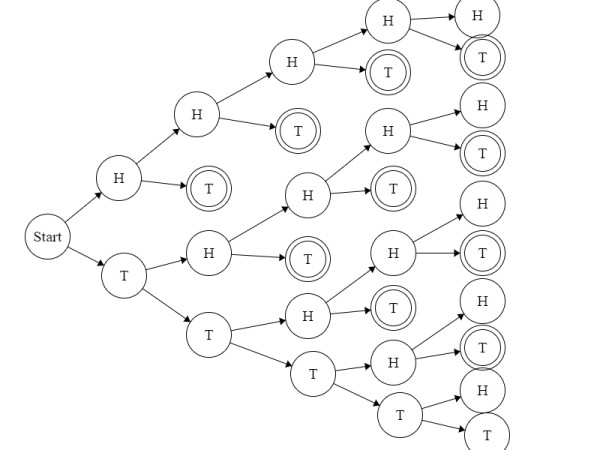


Probability in each branch $=0.5$. I double circled the satisfying toss events.
While observing the diagram I noticed that, from 2nd toss onward our required event starts showing up. Additionally,

 1. in the $\text{2nd}$ toss (or the 3rd level) we have one satisfying case.
 2. in the $\text{3rd}$ toss (or the 4th level) we have two satisfying case.
 3. in the $\text{4th}$ toss (or the 5th level) we have three satisfying case.
 4. in the $\text{5th}$ toss (or the 6th level) we have four satisfying case.
 5. etc.

i.e. in the $\text{kth}$ toss we would have $(k-1)$ satisfying case.
So,

$$\begin{align} E(x) &= \sum_{k=2}^{\infty } k.P(k)\\\ &= \sum_{k=2}^{\infty } k.\left \{ (k-1)*(0.5)^k \right \}\\ &= \sum_{k=2}^{\infty } \left \{ (k^2-k)*(0.5)^k \right \}\\ \end{align}$$

Using geometric series identity : https://en.wikipedia.org/wiki/Geometric_series#Geometric_power_series

$$\begin{align} \sum_{k=2}^{\infty}k(k-1)x^{k-2} = \frac{2}{(1-x)^3}\ \ \text{for } |x| < 1 \\ \end{align}$$

In our case : $x = 0.5$ So,

$$\begin{align} E &= \sum_{k=2}^{\infty}k(k-1)x^{k} = x^2\sum_{k=2}^{\infty}k(k-1)x^{k-2} = x^2.\frac{2}{(1-x)^3} \\ \end{align}$$

putting $x = \frac{1}{2}$   ; we get $E = 4$


More example:

For consecutive two heads ; HH

By drawing the tree diagram we can find the following series :


$$\begin{align*} E &= \sum{k.P(k) } \\ &=2.(1.x^2) + 3.(1.x^3) + 4.(2.x^4) + 5.(3.x^5)+6.(5.x^6)+7.(8.x^7)+.....\infty\\ \end{align*}$$

Above series is a nice combination of AP , generating function and Fibonacci numbers !!!!

  • AP terms can be handled by integration or differentiation
  • Fibanacci Generating function is = $\begin{align*} \frac{1}{1-x-x^2} \end{align*}$

 $$\begin{align} &\Rightarrow \frac{E}{x} =2.(1.x^1) + 3.(1.x^2) + 4.(2.x^3) + 5.(3.x^4)+6.(5.x^5)+7.(8.x^6)+.....\infty\\ &\Rightarrow \int \frac{E}{x} .dx = 1.x^2+1.x^3+2.x^4+3.x^5+5.x^6+.....\infty \\ &\Rightarrow \int \frac{E}{x} .dx = x^2.\left ( 1.x^0+1.x^1+2.x^2+3.x^3+5.x^4+.....\infty \right ) \\ &\Rightarrow \int \frac{E}{x} .dx = \frac{x^2}{1-x-x^2} \\ &\Rightarrow \frac{E}{x} = \frac{\mathrm{d}}{\mathrm{d} x}\left [ \frac{x^2}{1-x-x^2} \right ] \\ &\Rightarrow \frac{E}{x} = \frac{2x(1-x-x^2)+(1+2x)x^2}{(1-x-x^2)^2} \\ &\Rightarrow E = x.\left \{ \frac{2x(1-x-x^2)+(1+2x)x^2}{(1-x-x^2)^2} \right \} \\ &\Rightarrow E = \frac{1}{2}.\left \{ \frac{2.\frac{1}{2}(1-\frac{1}{2}-\frac{1}{4})+(1+2.\frac{1}{2}).\frac{1}{4}}{(1-\frac{1}{2}-\frac{1}{4})^2} \right \} \\ &\Rightarrow E = 6 \\ \end{align}$$

Infact 2nd QS on HT can also be done in the above way using integration.

Correct Answer: $A$

edited by
137 137 votes

Answer is (A)

$E(X)= \sum X_{i} \times P_{i}$

Where X=no of tosses when you get successive HEAD/TAIL(only one is possible at a time though).

$P_{i}$=Probability that you get in $X_{i}$ tosses.

Now see solution:  

You need atleast 2 tosses to get 2 heads/tails. Now see if you throw twice probability to get 2 heads/tails is $\dfrac{1}{2}$ out of $4$ outcomes $[HT,HH,TH,TT].$

Similarly if you get result in $3rd$ toss that means you did not get in $2nd$ toss so favourable cases for this can be $THH$ and $HTT$ only out of total $8$ outcomes. So probability is $\dfrac{2}{8}=\dfrac{1}{2^{2}}.$

To generalize ,you can see that in every case you will have only two favourable cases and $2^{n}$ sample space. So for n th throw probability is $\dfrac{1}{(2^{n-1})}.$

Now coming to $E(X)= 2\times \dfrac{1}{2} + 3\times \dfrac{1}{4} + 4\times \dfrac{1}{8}+\ldots \text{till infinity}.$

See this is combined AP-GP, So multiplying E(X) by $\dfrac{1}{2}$ and subtracting from E(X).

$E(X)=2\times \dfrac{1}{2}+ 3\times {1}{4} +4 \times \dfrac{1}{8}+\ldots$

${0.5}\times E(X)=2\times \dfrac{1}{4} +3\times \dfrac{1}{8}+\ldots$

subtracting, we get $\frac{1}{2} \times E(X)= 1+\frac{1}{4}+\dfrac{1}{8}+\dfrac{1}{16}+\ldots$

${0.5} \times E(X)= 1+ \left(\dfrac{1}{4}\right)\div {\left(1-{0.5}\right)}= 1+\dfrac{1}{2} =\dfrac{3}{2}$             $\left(\frac{a}{1-r}\right)$

     $ E(x)= 3.$  

edited by
7 7 votes
Number of expected toss to get a head (or tail), E(H) = E(T) = 2

let the expected number of tosses to get two successive same outcome is e.

e = 1/2*(1+E(H)) + 1/2*(1+E(T))

e = 1/2*(1+2) + 1/2 *(1+2)

e = 3


Therefore correct answer would be (A).


Answer is right, but procedure is wrong.
edited by
4 4 votes

Let the expected number of coin flips be X.

The case analysis goes as follows:

a. If the first and second flips are HH or TT then we are done. The probability of this event is 2*(1/4) = 1/2

and the total number of flips required is 2.

b.if the first and second flips are TH or HT then we wasted 2 flips. The probability of this event is 2*(1/4) = 1/2

and the total number of flips required is X+2.

Adding, the equation  we get -
X=1/2(2)+1/2(X+2)

solving equation we get X = 3

answer : 3

1 flag:
✌ Edit necessary (js__)
4 4 votes
This is going to be a long one. Let’s start.

Definition – $\bf{X}$ :- This is a random variable which denotes the number of tosses required to get two consecutive tosses with the same outcome.

$P(X=1) = 0$ . This is because we need atleast two tosses to get two consecutive tosses.

$(P(X=2)=$ {$H,H$} or {$T,T$} = $\frac{1}{2}$

Notice that for any sequence of coin tosses, if the last two outcomes are {$T,T$} or {$H,H$} then $\exists$ only one valid sequence for the preceding part of it. Hence for every value of $X$, there are only two valid sequences.

For example if ($X=5$) and the last two outcomes are the same, then the possibilities are : $\color{red}{xxx}TT$ and $\color{red}{xxx}HH$

There is only possibility for $\color{red}{xxx}$ for each of the outcomes, which are $\color{red}{HTH}TT$ and $\color{red}{THT}HH$ respectively. Otherwise, we’d get a smaller sequence with same outcomes which refutes our definition of $X$.

Therefore $P(X=n)=\frac{2}{2^n}=\frac{1}{2^{n-1}}$ …. $\bf{(i)} $ for $ n \geq 2 $

We know, $\bf{E[X]}= \sum_{x} x \times p(x)$

Let us denote $\bf{E[X]}$ by S.

$ S= P(X=1) \times 1 + P(X=2) \times 2+ …… $to $\infty$

$S= 0+ 2 \times \frac{1}{2^1} + 3 \times \frac{1}{2^2} + 4 \times \frac{1}{2^3}… $ to $\infty$ – $\bf(iii)$

$2S= 0+ 2 \times \frac{1}{2^1} \times 2 + 3 \times \frac{1}{2^2} \times 2 + 4 \times \frac{1}{2^3} \times 2… $ to $\infty$ -$(\bf{iv})$

Subtracting $\bf{(iv)}$ from $\bf({iii})$ we have :

$S= 2 + \frac{1}{2}+ (3-2)\frac{1}{2^2}+ (4-3)\frac{1}{2^3}+ \frac{1}{2^4} ….$ to $\infty$

$S= 2 + \frac{\frac{1}{2}}{1-\frac{1}{2}}=2+1=3$

Hence, the expected value $\bf{E[X]}$=3.
3 3 votes
This can be solved using recurrence relation as follows:
Let X be the expected value of number of tosses until the outcomes of 2 tosses are same.
We win when outcomes are HH,TT and we lose when outcomes are HT,TH.


So Prob(win) = 1/2 and Prob(lose) = 1/2

In the case of winning after first coin is tossed it needs one more toss to win while in the case of lose, after tossing first time we need to toss X more times as we could not win.
This gives us a Recurrence relation as follows:

X = 1/2∗(1+1) + 1/2∗(1+X)
2X = 2+1+X
X = 3
Answer:
Position:
Show:

Related questions

59 59 votes
11 answers 11 answers
18.0k
18.0k views
Ishrat Jahan asked Oct 31, 2014
17,969 views
When a coin is tossed, the probability of getting a Head is $p, 0 < p < 1$. Let $N$ be the random variable denoting the number of tosses till the first Head appears, incl...
49 49 votes
5 answers 5 answers
13.7k
13.7k views
Ishrat Jahan asked Nov 3, 2014
13,665 views
A bag contains $10$ blue marbles, $20$ green marbles and $30$ red marbles. A marble is drawn from the bag, its colour recorded and it is put back in the bag. This process...
58 58 votes
6 answers 6 answers
15.3k
15.3k views
Ishrat Jahan asked Nov 3, 2014
15,330 views
In a communication network, a packet of length $L$ bits takes link $L_1$ with a probability of $p_1$ or link $L_2$ with a probability of $p_2$. Link $L_1$ and $L_2$ have ...
29 29 votes
5 answers 5 answers
8.7k
8.7k views
Ishrat Jahan asked Oct 29, 2014
8,698 views
Suppose there are two coins. The first coin gives heads with probability $\dfrac{5}{8}$ when tossed, while the second coin gives heads with probability $\dfrac{1}{4}.$ On...