Let's first Define Eigen vector, which is.
An eigenvector is a non-zero vector within a vector space that, when multiplied by a given square matrix, results in a scaled version of itself.
Av=λv
Let's just remove the 'non-zero vector' part for a while and lets feel practically, what is an eigenvector.
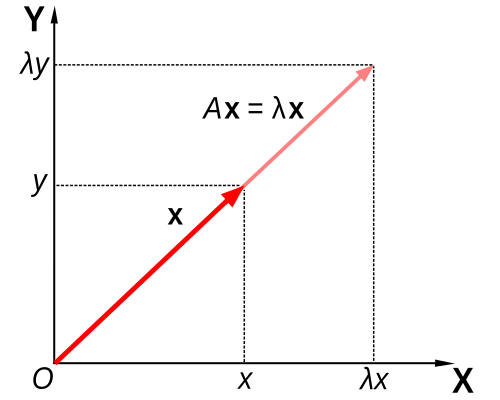
So, eigenvector is a direction within a space, that remains unchanged when any linear transformation is applied.
Again, eigenvector is a direction.
Can direction be 0?
Can direction be Null?
Can direction be empty?
I'll ask a more simpler real life question.
We are living in a 3-D world.
1. Close one eye.
2. Look constant in one direction of your choice.
3. Draw a (x,y,z) graph in your mind with (0,0,0) where your open eye is.
Can you say that you are looking at (0,0,0). You can't because you cannot see your open eye from your open eye. IMPOSSIBLE.
Now, I'll give another practical example.
Imagine you have a square piece of paper with an arrow drawn on it. Now, you apply some transformation to this paper, like folding, stretching (let's say its a stretchable paper), or rotating. An eigenvector in this case would be a direction on the paper where the arrow remains pointing in the same direction after the transformation, possibly getting longer or shorter.
1. Stretching: If you stretch the paper horizontally, the arrow might get longer or shorter, but there might be a direction on the paper where the arrow stays pointing in the same direction. That direction is an eigenvector.
2. Rotation: If you rotate the paper, there might be a direction where the arrow remains pointing in the same direction relative to the paper's new orientation. That direction is another eigenvector.
3. Folding: Even if you fold the paper, there might be a crease along which the arrow remains aligned. That crease direction is also an eigenvector.
Now, read this line again
The eigenvector represents a direction on the paper that remains relatively unchanged after the transformation, except for a possible scaling (stretching or compressing), which is represented by the eigenvalue
Ofcourse, this was to make anyone feel what an eigenvector and eigenvalue is. The real answer to this question is that the poor guy is defined to be a non-zero vector.
