• edited by
21,896 views
43 43 votes

Consider the following C functions:

int f1 (int n)
{
    if(n == 0 || n == 1)
        return n;
    else
        return (2 * f1(n-1) + 3 * f1(n-2));
}
int f2(int n)
{
    int i;
    int X[N], Y[N], Z[N];
    X[0] = Y[0] = Z[0] = 0;
    X[1] = 1; Y[1] = 2; Z[1] = 3;
    for(i = 2; i <= n; i++){
        X[i] = Y[i-1] + Z[i-2];
        Y[i] = 2 * X[i];
        Z[i] = 3 * X[i];
    }
    return X[n];
}

$f1(8)$ and $f2(8)$ return the values

  1. $1661$ and $1640$
  2. $59$ and $59$
  3. $1640$ and $1640$
  4. $1640$ and $1661$

6 Answers

Best answer
30 30 votes

Both $f1$ and $f2$ are calculating the same function in recursive and iterative fashion respectively.

So. lets solve the recurrence relation.

$F(n) = 2 F(n-1) + 3F(n-2)$

Its characteristic equation will be
$r^{2}- 2r- 3 = 0$
$\implies (r-3) (r+1) = 0$
$\implies r = 3, -1$

Now, we have two roots. So the equation will be

$a_{n} = C_{1}(-1^{n}) + C_{2}(3^{n}) \qquad \to (1)$

Now from the function  $f1,$

$F(0) = 0$ and  $F(1) = 1$

So, $C_{1} + C_{2} = 0$
$\quad -C_{1} + 3C_{2} = 1$

$\implies C_{1} = -1/4$  and  $C_{2} = 1/4$

After putting the values in $(i)$ the equation will become

$a_{n} = (-1/4)(-1^{n}) +(1/4)(3^{n})$

Putting $n= 8$ it will become  

$F(8) = a_{8} = 1640.$


Or we can do it manually

$f1(2) = 2f1(1) + 3f1(0) = 2$
$f1(3) = 2f1(2) + 3f1(1) = 7$
$f1(4) = 20$
$f1(5) = 61$
$f1(6) = 182$
$f1(7) = 547$
$f1(8) = 1640 = f2(8)$

• selected by
1 flag:
✌ Edit necessary (Arjun)
29 29 votes

Here, answer is C. $1640$ and $1640$

$f1(8)$


$f2(8)$ will return 1640


• edited by
17 17 votes

First, we'll see what $f1(8)$ will return
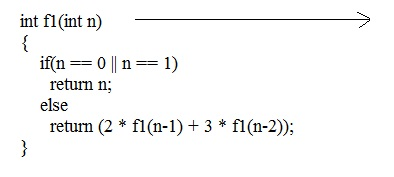
int f1(int n)
{
if(n == 0 || n == 1)
return n;
else
return(2*f1(n-1) + 3 * f1(n-2));
}
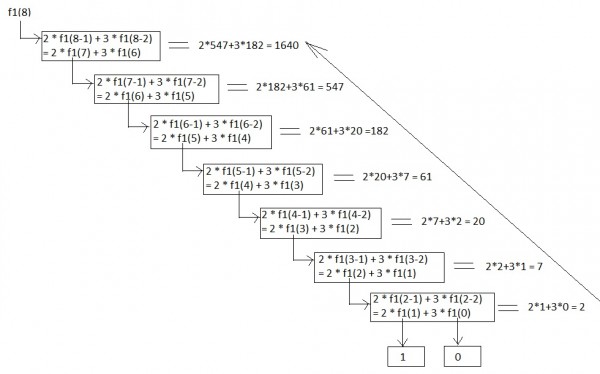
 

∴ $f1(8)$ returns $1640$

Now, what $f2(8) $ will return --

int i;

We can take any values of $i$, but at the end, we want the return value as $X[n]$, so we'll going to take $i=8$

int X[N], Y[N], Z[N];

The above line creates $3$ arrays 
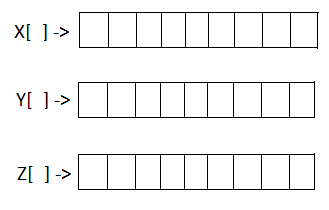
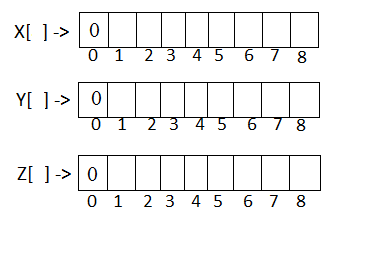
X[0] = Y[0] = Z[0] = 0;

This will set all the index $0$ position of all the $3$ arrays to $0$
 

X[1] = 1; Y[1] = 2; Z[1] = 3;
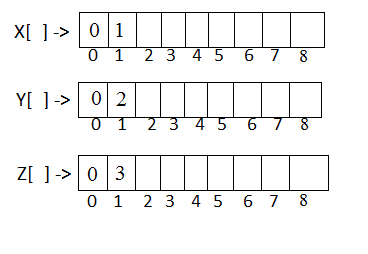
for(i=2; i<= n; i++)

This loop will run from $i=2$ to $i=8$

X[i] = Y[i-1] + Z[i-2];
Y[i] = 2 * X[i];
Z[i] = 3 * X[i];

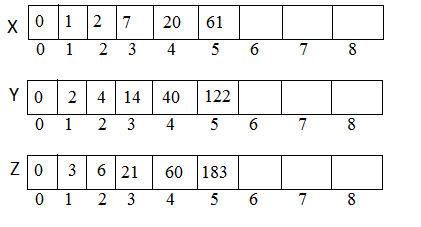
when $i = 2$ ,

$X[ i ] = Y[ i-1 ] + Z[ i-2 ]$ $\rightarrow X[2] = Y[2-1] + Z[2-2] \\ = Y[1] + Z[0] = 2 + 0 \\ = 2$

$Y[i] = 2 * X[i]$ $\rightarrow Y[2] = 2 * X[2] \\ = 2 * 2 \\ = 4$

$Z[i] = 3 * X[i]$ $\rightarrow Z[2] = 3 * X[2] \\ = 3 * 2 \\ = 6$

when $i = 3$ ,

$X[ i ] = Y[ i-1 ] + Z[ i-2 ]$ $\rightarrow X[3] = Y[3-1] + Z[3-2] \\ = Y[2] + Z[1] = 4 + 3 \\ = 7$

$Y[i] = 2 * X[i]$ $\rightarrow Y[3] = 2 * X[3] \\ = 2 * 7 \\ = 14$

$Z[i] = 3 * X[i]$ $\rightarrow Z[3] = 3 * X[3] \\ = 3 * 7 \\ = 21$

when $i = 4$ ,

$X[ i ] = Y[ i-1 ] + Z[ i-2 ]$ $\rightarrow X[4] = Y[4-1] + Z[4-2] \\ = Y[3] + Z[2] = 14 + 6 \\ = 20$

$Y[i] = 2 * X[i]$ $\rightarrow Y[4] = 2 * X[4] \\ = 2 * 20 \\ = 40$

$Z[i] = 3 * X[i]$ $\rightarrow Z[4] = 3 * X[4] \\ = 3 * 20 \\ = 60$

when $i = 5$ ,

$X[ i ] = Y[ i-1 ] + Z[ i-2 ]$ $\rightarrow X[5] = Y[5-1] + Z[5-2] \\ = Y[4] + Z[3] = 40 + 21 \\ = 61$

$Y[i] = 2 * X[i]$ $\rightarrow Y[5] = 2 * X[5] \\ = 2 * 61 \\ = 122$

$Z[i] = 3 * X[i]$ $\rightarrow Z[5] = 3 * X[5] \\ = 3 * 61 \\ = 183$
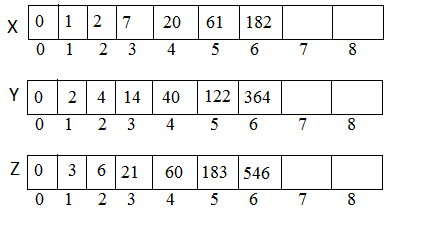
when $i = 6$ ,

$X[ i ] = Y[ i-1 ] + Z[ i-2 ]$ $\rightarrow X[6] = Y[6-1] + Z[6-2] \\ = Y[5] + Z[4] = 122 + 60 \\ =182$

$Y[i] = 2 * X[i]$ $\rightarrow Y[6] = 2 * X[6] \\ = 2 * 182 \\ = 364$

$Z[i] = 3 * X[i]$ $\rightarrow Z[6] = 3 * X[6] \\ = 3 * 182 \\ = 546$
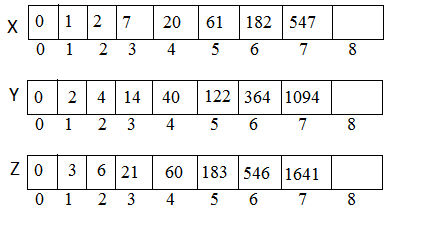
when $i = 7$ ,

$X[ i ] = Y[ i-1 ] + Z[ i-2 ]$ $\rightarrow X[7] = Y[7-1] + Z[7-2] \\ = Y[6] + Z[5] = 364 + 183 \\ = 547$

$Y[i] = 2 * X[i]$ $\rightarrow Y[7] = 2 * X[7] \\ = 2 * 547 \\ = 1094$

$Z[i] = 3 * X[i]$ $\rightarrow Z[7] = 3 * X[7] \\ = 3 * 547 \\ = 1641$
when $i = 8$ ,

$X[ i ] = Y[ i-1 ] + Z[ i-2 ]$ $\rightarrow X[8] = Y[8-1] + Z[8-2] \\ = Y[7] + Z[6] = 1094 + 546 \\ = 1640$

$Y[i] = 2 * X[i]$ $\rightarrow Y[8] = 2 * X[8] \\ = 2 * 1640 \\ = 3280$

$Z[i] = 3 * X[i]$ $\rightarrow Z[8] = 3 * X[8] \\ = 3 * 1640 \\ = 4920$
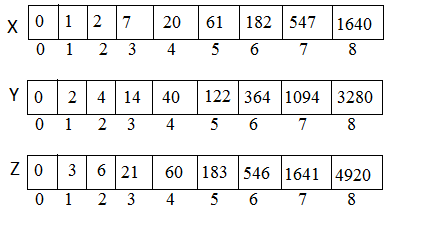
Now we'll be coming out from for loop & execute the last statement

return X[n];

which will return $X[n]$ i.e. $X[8]$ which is $1640$

∴ $f1(8)$ will return $1640$ & $f2(8)$ will also return $1640$

The correct option will be C).

• edited by
7 7 votes
Both functions are same. One is the recursive version and other is the itrative version. so find anyones's value is sufficient.

let's find value of f1(8).

f1(0)=0

f1(1)=1

f1(2)=2*f1(1) + 3*f1(0) = 2;   likewise for others

f1(3)=4 + 3 = 7

f1(4)=14 + 6 = 20

f1(5)=40 + 21 = 61

f1(6)=122 + 60 = 182

f1(7)=364 + 183 = 547

f1(8)= 1094 + 546 = 1640

(C.) is the answer.
2 2 votes
f1 and f2 are computing same function. f1 is Top Down  method using recursion and f2 is  Bottom Up method using DP.

This problem could be solved via forming recurrence relation. Solution of Homogenous recurrence relation is ->

a(n) = $\frac{1}{4}*(3^n - (-1)^n)$

a(8) = 1640.

Hence answer is C part.
• edited by
0 0 votes
Smart way to answer:(Exam approach)

By analyzing f1 and f2 we are sure that both codes are same so answer of f1=f2( option A and D gon)

By running couple of steps we are sure that answer will be a big number so (option B gon)

C is correct answer 😊
Answer:
Position:
Show:

Related questions

74 74 votes
4 answers 4 answers
35.7k
35.7k views
Kathleen asked Sep 12, 2014
35,695 views
Which of the following are NOT true in a pipelined processor?Bypassing can handle all RAW hazardsRegister renaming can eliminate all register carried WAR hazardsControl h...
51 51 votes
7 answers 7 answers
30.3k
30.3k views
Kathleen asked Sep 12, 2014
30,302 views
Consider the following C functions:int f1 (int n) { if(n == 0 || n == 1) return n; else return (2 * f1(n-1) + 3 * f1(n-2)); } int f2(int n) { int i; int X[N], Y[N], Z[N];...
70 70 votes
9 answers 9 answers
34.2k
34.2k views
Kathleen asked Sep 12, 2014
34,205 views
We have a binary heap on $n$ elements and wish to insert $n$ more elements (not necessarily one after another) into this heap. The total time required for this is$\Theta(...
101 101 votes
9 answers 9 answers
55.4k
55.4k views
Kathleen asked Sep 12, 2014
55,395 views
The minimum number of comparisons required to determine if an integer appears more than $\frac{n}{2}$ times in a sorted array of $n$ integers is$\Theta(n)$$\Theta(\log n)...