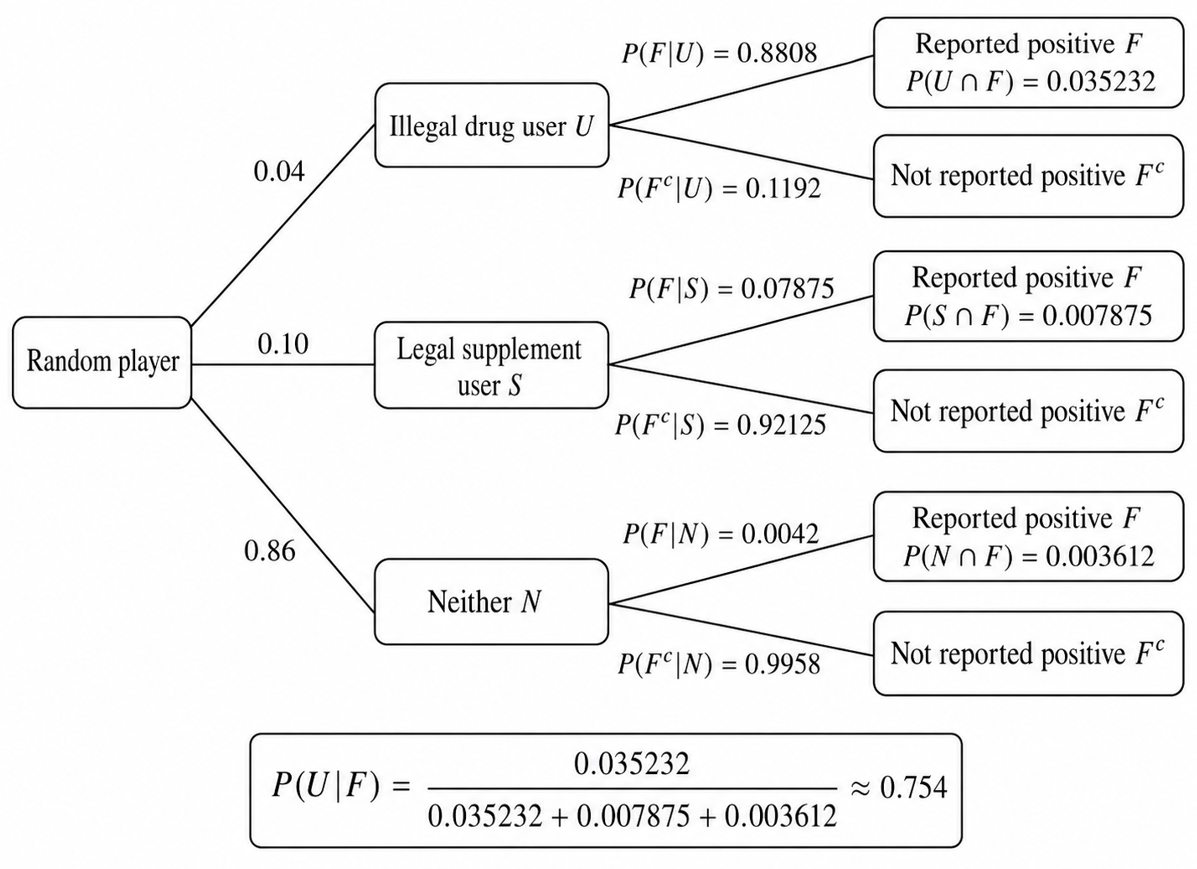
First, let's find the overall probability of a randomly chosen player belonging to each of the three categories: Drug User ($D$), Supplement User ($S$), or Neither ($N$).
We are given that $60\%$ $(0.60)$ of players are in Group A and $40\%$ $(0.40)$ are in Group B. We use the law of total probability to combine the percentages from both groups:
Probability of an actual drug user ($D$):
$P(D) = P(D|A)P(A) + P(D|B)P(B)$
$P(D) = (0.02)(0.60) + (0.07)(0.40) = 0.012 + 0.028 = \mathbf{0.040}$
Probability of a supplement user ($S$):
$P(S) = P(S|A)P(A) + P(S|B)P(B)$
$P(S) = (0.08)(0.60) + (0.13)(0.40) = 0.048 + 0.052 = \mathbf{0.100}$
Probability of a player using neither ($N$):
$P(N) = P(N|A)P(A) + P(N|B)P(B)$
$P(N) = (0.90)(0.60) + (0.80)(0.40) = 0.540 + 0.320 = \mathbf{0.860}$
(Self-check: $0.04 + 0.10 + 0.86 = 1.00$. The probabilities sum to $1$.)
Now, A player is reported positive ($R+$) only if the initial screening test ($T+$) is positive AND the subsequent lab confirmation ($L+$ or $M+$) is also positive.
Since Lab $L$ is chosen $75\%$ ($\frac{3}{4}$) of the time and Lab $M$ is chosen $25\%$ ($\frac{1}{4}$) of the time, the formula for a reported positive for any category $C$ is:
$$P(R+ | C) = P(T+ | C) \times [P(L)P(L+ | T+, C) + P(M)P(M+ | T+, C)]$$
Let's calculate this for each type of player:
For an actual drug user ($D$):
$$P(R+ | D) = 0.96 \times [(0.75 \times 0.93) + (0.25 \times 0.88)]$$
$$P(R+ | D) = 0.96 \times [0.6975 + 0.22]$$
$$P(R+ | D) = 0.96 \times 0.9175 = \mathbf{0.8808}$$
For a legal-supplement user ($S$):
$$P(R+ | S) = 0.18 \times [(0.75 \times 0.40) + (0.25 \times 0.55)]$$
$$P(R+ | S) = 0.18 \times [0.30 + 0.1375]$$
$$P(R+ | S) = 0.18 \times 0.4375 = \mathbf{0.07875}$$
For a player using neither ($N$):
$$P(R+ | N) = 0.03 \times [(0.75 \times 0.12) + (0.25 \times 0.20)]$$
$$P(R+ | N) = 0.03 \times [0.09 + 0.05]$$
$$P(R+ | N) = 0.03 \times 0.14 = \mathbf{0.0042}$$
We need to find the probability that a player is an actual drug user given that they received a reported positive, $P(D | R+)$.
$$\Rightarrow P(D | R+) = \frac{P(R+ | D) P(D)}{P(R+ | D) P(D) + P(R+ | S) P(S) + P(R+ | N) P(N)}$$
$$\Rightarrow P(D | R+) = \frac{0.8808 \times 0.040}{(0.8808 \times 0.040) + (0.07875 \times 0.100) + (0.0042 \times 0.860)}$$
$$\Rightarrow P(D | R+) = \frac{0.035232}{0.046719} \approx \mathbf{0.754...}$$
$$\boxed{\therefore P(D | R+) = \mathbf{0.754}}$$