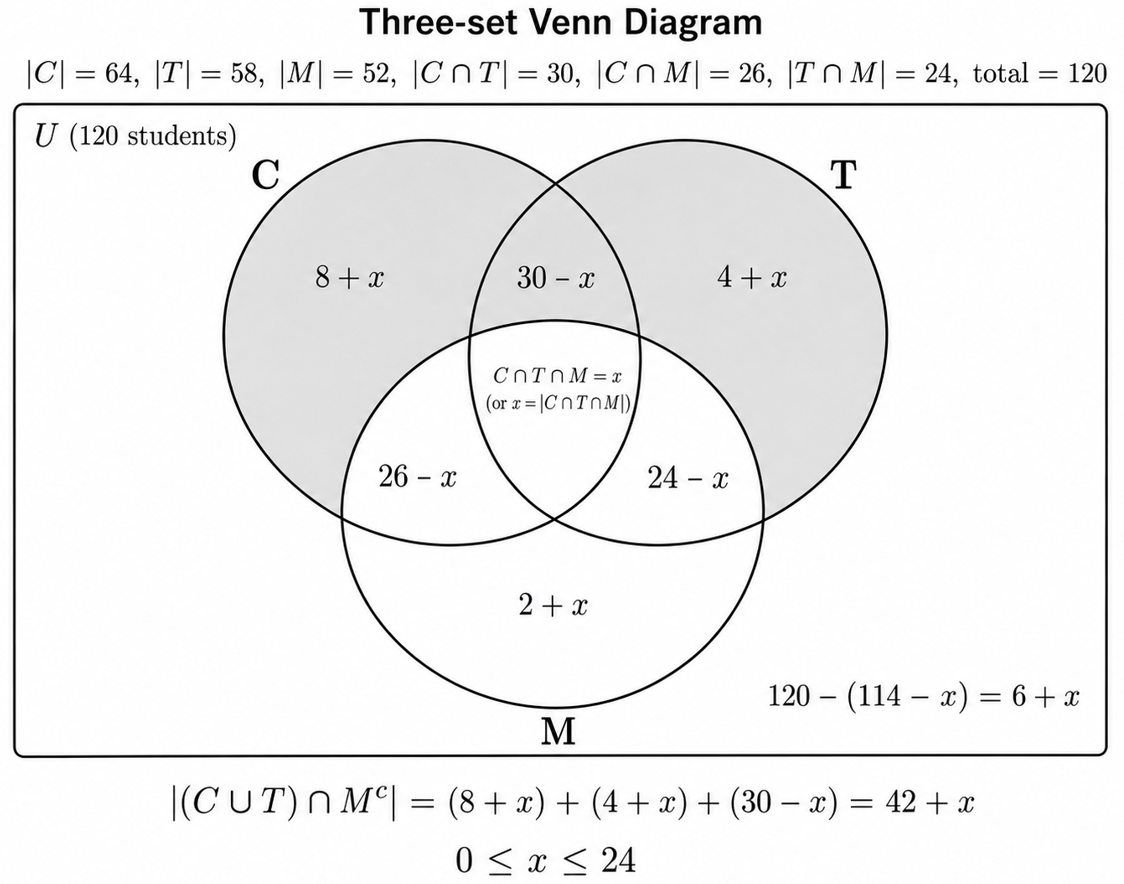
Given Information :
Let $x$ be the number of students in all three clubs: $x = |C \cap T \cap M|$
We are looking for the probability of the event $(C \cup T) \cap M^c$. This represents the set of students who are in club $C$ or club $T$ (or both), but not in club $M$. The number of students in this set is:
$$|(C \cup T) \cap M^c| = |C \cup T| - |(C \cup T) \cap M|$$
First, let's find $|C \cup T|$:
$$|C \cup T| = |C| + |T| - |C \cap T|$$
$$|C \cup T| = 64 + 58 - 30 = 92$$
Next, let's find $|(C \cup T) \cap M|$: Using the distributive property of sets, this is equal to $|(C \cap M) \cup (T \cap M)|$.
$$|(C \cap M) \cup (T \cap M)| = |C \cap M| + |T \cap M| - |(C \cap M) \cap (T \cap M)|$$
Notice that $(C \cap M) \cap (T \cap M)$ is exactly the intersection of all three sets, which we defined as $x$.
$$|(C \cup T) \cap M| = 26 + 24 - x = 50 - x$$
Now, substitute these back into our target set equation:
$$|(C \cup T) \cap M^c| = 92 - (50 - x)$$
$$|(C \cup T) \cap M^c| = 42 + x$$
The probability $p$ is the size of this set divided by the total number of students:
$$p = \frac{42 + x}{120}$$
To find the range of $p$, we need to find the minimum and maximum possible values for $x$. Every distinct region in a Venn diagram must have a non-negative number of students ($\ge 0$). Let's check the constraints this puts on $x$:
The number of students in all three clubs must be at least 0:$x \ge 0$
The number of students in $T \cap M$ but not $C$ must be non-negative:$|T \cap M| - x \ge 0 \implies 24 - x \ge 0 \implies x \le 24$
The number of students in $C \cap M$ but not $T$:$26 - x \ge 0 \implies x \le 26$
The number of students in $C \cap T$ but not $M$:$30 - x \ge 0 \implies x \le 30$
Students only in $M$:$|M| - |C \cap M| - |T \cap M| + x \ge 0 \implies 52 - 26 - 24 + x \ge 0 \implies 2 + x \ge 0 \implies x \ge -2$ (We already know $x \ge 0$)
The most restrictive bounds on $x$ are $0 \le x \le 24$.
Now plug the minimum and maximum values of $x$ into our probability equation:
Minimum $p$ (when $x = 0$):
$$p_{min} = \frac{42 + 0}{120} = \frac{42}{120} = \frac{7}{20}$$
Maximum $p$ (when $x = 24$):
$$p_{max} = \frac{42 + 24}{120} = \frac{66}{120} = \frac{11}{20}$$
Therefore, the range of possible values for $p$ is:
$$\boxed{\frac{7}{20} \le p \le \frac{11}{20}}$$