243 views
2 2 votes

The point of inflection of the function $y=e^x(\sin x-\cos x)$ in $[0,\pi]$ is:

  1. $x=\dfrac{\pi}{4}$

     
  2. $x=\dfrac{3\pi}{4}$

     
  3. $x=\dfrac{\pi}{4},\dfrac{3\pi}{4}$

     
  4. No point of inflection

1 Answer

0 0 votes

We are given $y=e^x(\sin x-\cos x)$.

To find a point of inflection, we need $y''=0$ and the concavity must change sign.

First differentiate using the product rule:

$y'=e^x(\sin x-\cos x)+e^x(\cos x+\sin x)$

Simplify:

$y'=e^x(2\sin x)$

$y'=2e^x\sin x$

Differentiate again:

$y''=2e^x\sin x+2e^x\cos x$

$y''=2e^x(\sin x+\cos x)$

Now set $y''=0$:

$2e^x(\sin x+\cos x)=0$

Since $2e^x>0$ for all $x$, we only need

$\sin x+\cos x=0$

So,

$\tan x=-1$

In the interval $[0,\pi]$, this gives

$x=\frac{3\pi}{4}$
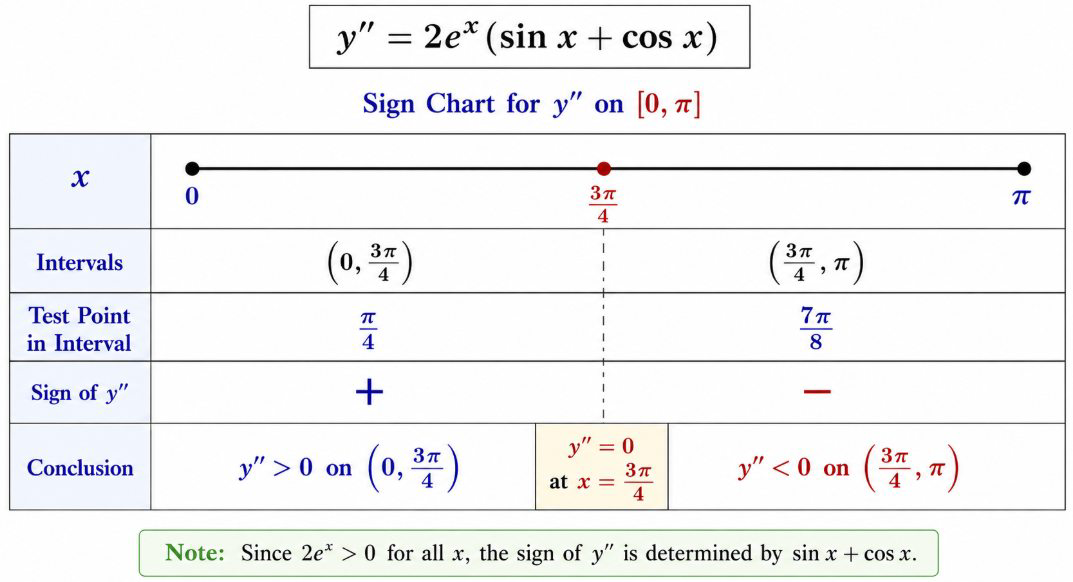
Now check whether the sign of $y''$ changes at $x=\frac{3\pi}{4}$.

Since $2e^x>0$, the sign of $y''$ depends only on $\sin x+\cos x$.

For $0<x<\frac{3\pi}{4}$, $\sin x+\cos x>0$, so $y''>0$ and the curve is concave up.

For $\frac{3\pi}{4}<x<\pi$, $\sin x+\cos x<0$, so $y''<0$ and the curve is concave down.

Therefore, concavity changes at $x=\frac{3\pi}{4}$.

Answer: B. $x=\frac{3\pi}{4}$

• edited by
Answer:
Position:
Show:

Related questions

1 1 vote
1 1 answer
221
221 views
GO Classes asked May 28
221 views
The point(s) of inflection of the curve $$y=\frac{2}{5}x^6-\frac{9}{5}x^5-3x^4+22x^3-36x^2+5x+1$$ is/are:$x=-2,1,3$ $x=-2$ and $x=3$ only $x=1$ only None of the above
0 0 votes
1 1 answer
305
305 views
GO Classes asked May 29
305 views
The length of the curve $y=\frac{1}{3}\left((x-1)^2+2\right)^{3/2}$ for $-1\leq x\leq2$ is:$5$ $6$ $\dfrac{20}{3}$ $8$
0 0 votes
1 1 answer
214
214 views
GO Classes asked May 29
214 views
The area of the region between the curves $y=x^2-2x$ and $y=2x-x^2$ for $x\in[-1,3]$ is:$4$ $\frac{16}{3}$ $\frac{20}{3}$ $8$
2 2 votes
1 1 answer
300
300 views
GO Classes asked May 29
300 views
The function $$f(x)=\begin{cases}x\sin\left(\frac{1}{x}\right),&x\neq0\\\\0,&x=0\end{cases}$$ at $x=0$ is:Continuous and differentiable Continuous but not differentiable ...