Given $\mathrm{F}(\mathrm{A},\mathrm{B},\mathrm{C})=\Sigma _m(1,3,4,5,7)$.
Place $1$s in the K-map at cells $m_1,m_3,m_4,m_5,m_7$.
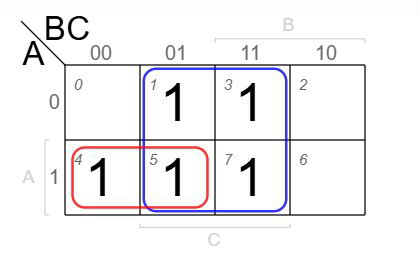
Now make the largest possible groups.
First, group $m_1,m_3,m_5,m_7$ together.
In this group, $\mathrm{A}$ changes from $0$ to $1$, and $\mathrm{B}$ changes from $0$ to $1$.
Only $\mathrm{C}=1$ remains constant.
So, this group gives the term $\mathrm{C}$.
Now $m_4$ is left uncovered.
Group $m_4$ with $m_5$.
In this group, $\mathrm{C}$ changes from $0$ to $1$.
But $\mathrm{A}=1$ and $\mathrm{B}=0$ remain constant.
So, this group gives the term $\mathrm{A}\mathrm{B}'$.
Therefore, the minimal SOP form is $\mathrm{F}=\mathrm{C}+\mathrm{A}\mathrm{B}'$.
Answer: B
