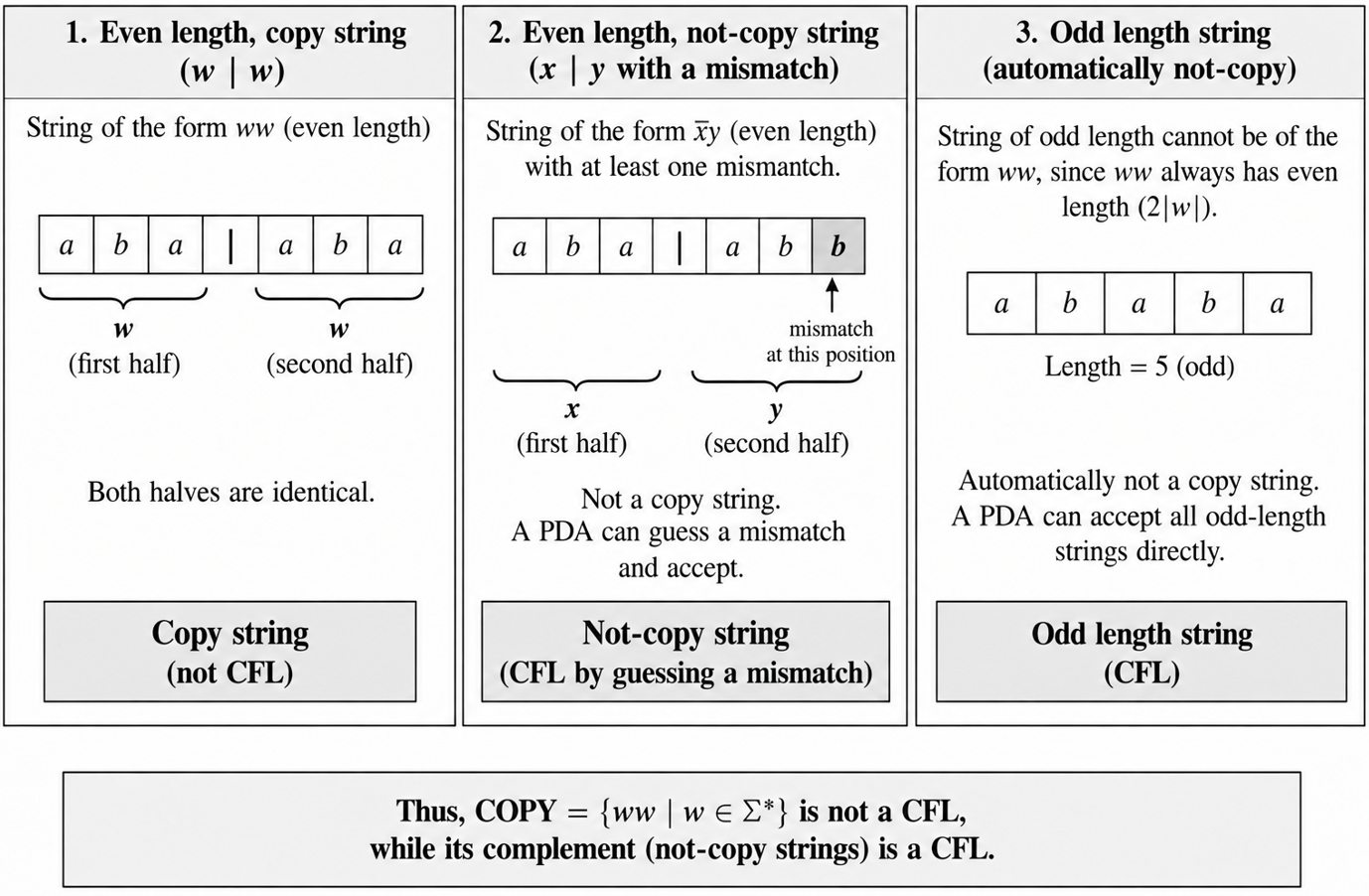
Let $\text{COPY}=\{ww\mid w\in\{a,b\}^*\}$ and $\text{NOTCOPY}=\{x\in\{a,b\}^*\mid x\text{ is not of the form }ww\}$.
A. True
$\text{COPY}$ is a standard example of a language that is not context-free.
A PDA with one stack cannot store an arbitrary first half $w$ and then compare the second half with it in the same order.
Hence, $\text{COPY}\notin$ CFL.
B. True
$\text{NOTCOPY}$ is context-free.
There are two possibilities for a string to be in $\text{NOTCOPY}$:
An NPDA can nondeterministically guess a position where the two halves differ and verify the required length relationship using its stack.
Hence, $\text{NOTCOPY}\in$ CFL.
C. False
From $\text{COPY}\notin$ CFL we cannot conclude that its complement is also not CFL.
CFLs are not closed under complement.
In this particular case, $\text{COPY}\notin$ CFL but $\text{NOTCOPY}\in$ CFL.
D. True
Every string of the form $ww$ has length $|ww|=2|w|$, which is always even.
Therefore, every odd-length string cannot be of the form $ww$.
So every odd-length string belongs to $\text{NOTCOPY}$.
E. True
Suppose a string has even length $2n$.
Split it into two equal halves:
$x=uv$, where $|u|=|v|=n$.
If $x$ is not of the form $ww$, then $u\neq v$.
Therefore, there must be at least one position $i$ such that the $i$-th symbol of $u$ differs from the $i$-th symbol of $v$.
Hence statement E is true.