• edited by
23,613 views
96 96 votes

Let $X$ and $Y$ be finite sets and $f:X \to Y$ be a function. Which one of the following statements is TRUE?

  1. For any subsets $A$ and $B$ of $X, |f(A \cup B)| = |f(A)| + |f(B)|$
  2. For any subsets $A$ and $B$ of $X, f(A \cap B) = f(A) \cap f(B)$
  3. For any subsets $A$ and $B$ of $X, |f(A \cap B)| = \min \{|f(A)|, |f(B)|\}$
  4. For any subsets $S$ and $T$ of $Y, f^{-1}(S \cap T) = f^{-1}(S) \cap f^{-1}(T)$

6 Answers

Best answer
126 126 votes

3 out of 4 options can be eliminated with the help of a counter example.

Let $X = \{ a , b , c \}$ and $Y = \{ 1 , 2 \}$
A Function $f$ maps each element of $X$ to exactly one element in $Y$.
Let $f(a)=1 , f(b)=1 , f(c) =1$ and $A = \{ a  \}, B = \{ b , c \}$


A)

  • LHS: $|f ( A \cup B )| = |f (\{a,b,c\})| = |\{1\}| = 1$
  • RHS: $|f(A)|+|f(B)| = 1 + 1 = 2$ ,
  • $\textbf{LHS} \neq \textbf{RHS}$

B)

  • LHS: $f ( A  \cap B ) = f (\{\}) = \{\}$.
  • RHS: $f(A) \cap f(B) = \{ 1\} \cap \{ 1\} = \{ 1\}$
  • $\textbf{LHS} \neq \textbf{RHS}$

C)

  • LHS: $|f ( A  \cap B )| = |f (\{\})| = |\{ \}| = 0$
  • RHS: $\min\{|f(A)|,|f(B)|\} = \min(1,1) = 1$
  • $\textbf{LHS} \neq \textbf{RHS}$

D)

Its easy to see that this is true because in a function a value can be mapped only to one value. The option assumes inverse of function $f$ exists.


Answer is $D$.

• edited by
1 flag:
✌ Edit necessary (Sanjog karan “thats the notation for inverse image and its not inverse function”)
35 35 votes

f is a function from $X \rightarrow Y$

Let's consider options one by one and also consider whether we can have a failure case for each of the options

(A)

For any subsets A and B of X,$|f(A∪B)|=|f(A)|+|f(B)|$

This case can fail if A and B have atleast one common element, in that case AUB will count only total number of distinct elements in A and B and then it will find image of all such elements and give the count

But the RHS expression will separately give count for the number of images of A+Number of images of B.

Assume A={A,B} and B={B,C}. $|f(A)|=2$ and $|f(B)=2|$ and $|f(A \cup B)|=3$

So this option is clearly wrong.

(B) 

For any subsets A and B of X,$f(A∩B)=f(A)∩f(B)$

This can fail in case of Many to one function where A and B are completely disjoint but the image set of A and B overlap.
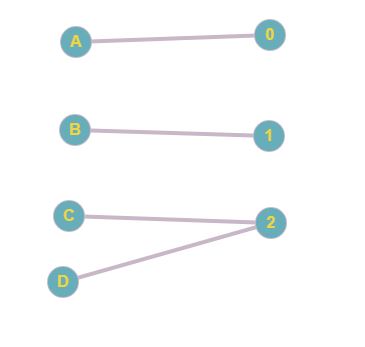
Take A={A,B} and B={C,D} LHS will come to be empty but RHS will have 2.

So this option also ruled out.

And through this reasoning also I rule out option (C)

(D) 

For any subsets S and T of Y, $f^{−1}(S∩T)=f^{−1}(S)∩f^{−1}(T)$

If they have defined inverse of the function f , this means f is invertible and hence one-to-one and onto.

Since f is bijective, whenever any subsets of Y, S and T overlap, their corresponding images in $f^{-1}$ would also overlap.

And if they don't overlap, then their images also won't.

ANS-D

1 flag:
✌ Edit necessary (Sanjog karan “Its the notation for inverse image and not inverse function”)
0 0 votes
What question wants to ask is for One-One Functions option B) always holds.

B) For One to One functions, whatever is common in A and B will also give the same image in Y else it will give different images. Eg F(a)=1, F(b)=2, and F(c)=3

A={a,b} and B={b,c}

In A /\ B = {b} then images of A and B will also give common element which is the image of b= 2. This is in agreement with One-One property if F(a)= F(b) then a=b only.

In D) option they have given a Bijective Function, which is One-One from both sides. So This property will hold in D)

A) and C) are easy to prove by taking counter examples. However, i can see that A) is definitely true if Function is One-One and A and B are disjoint sets(A /\ B = Null).

In C) This will be valid always only if either A is a subset of B or vice-versa((A /\ B) =A or B).
0 0 votes

I do see rigorous examples supporting Option(D) but not a rigorous proof. Although not mentioned in the question we must assume that the function has an inverse over the subsets $S,T$.

CLAIM:- Let $f:X \to Y$ be a function from $X$ to $Y$. Let $S,T$ be subsets of $Y$ such that $f$ has an inverse over these subsets. Then,

\[f^{-1}(S \cap T)=f^{-1}(S) \cap f^{-1}(T)\]


PROOF:-

Let $q\in f^{-1}( S\cap T)$. Then, 

\[f(q)\in S\cap T\] $\implies$

\[f(q)\in S  \wedge  f(q)\in T\]

So,

\[q\in f^{-1}(S) \wedge  q\in f^{-1}(T)\]

Finally,

\[q\in f^{-1}(S) \cap f^{-1}(T)\].

This is one side of the proof. The other side follows similarly by beginning with $q \in f^{-1}(S) \cap f^{-}(T)$ and proving that $q\in f^{-1}(S\cap T)$. 

Answer:
Position:
Show:

Related questions

124 124 votes
8 answers 8 answers
26.7k
26.7k views
go_editor asked Sep 28, 2014
26,695 views
Consider the set of all functions $f:\{0,1, \dots,2014\} \to \{0,1,\dots, 2014\}$ such that $ f\left(f\left(i\right)\right)=i$, for all $0 \leq i \leq 2014$. Consider th...
9 9 votes
5 answers 5 answers
8.9k
8.9k views
go_editor asked Sep 28, 2014
8,890 views
In the context of modular software design, which one of the following combinations is desirable?High cohesion and high couplingHigh cohesion and low couplingLow cohesion ...
105 105 votes
7 answers 7 answers
26.5k
26.5k views
go_editor asked Sep 28, 2014
26,522 views
There are two elements $x,\:y$ in a group $(G,*)$ such that every element in the group can be written as a product of some number of $x$'s and $y$'s in some order. It is ...
55 55 votes
3 answers 3 answers
12.7k
12.7k views
go_editor asked Sep 28, 2014
12,684 views
Let $G$ be a group with $15$ elements. Let $L$ be a subgroup of $G$. It is known that $L \neq\ G$ and that the size of $L$ is at least $4$. The size of $L$ is __________.