There are 2 parts of this question and it gave me a lot of clarity in DVR . I will try including the points where one can possibly have confusion in this question .
Part 1:
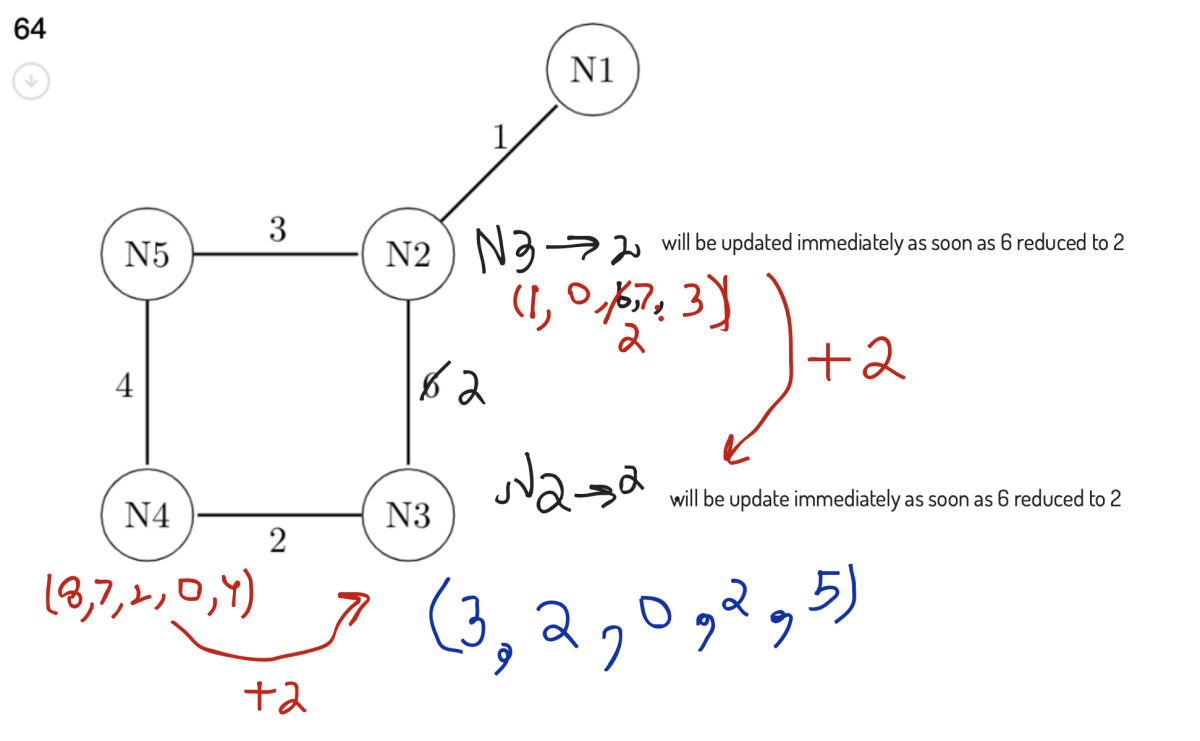
As soon as the cost of the link between N3 and N2 is reduced to 2, both N3 and N2 will immediately update their distance vectors. Specifically:
N3 updates its distance to N2 to 2, and
N2 updates its distance to N3 to 2.
However, other nodes (such as N4, N5, etc.) do not get affected immediately. This is because:
Between two update rounds, a change in link cost causes only the two directly connected nodes to update their distance vectors with respect to each other. The change does not propagate further until the next round of distance vector exchange.
Now, in the next update round, every node shares its updated distance vector with its immediate neighbors. So, N3 receives updated distance vectors from N2 and N4 (indicated by red arrows in the diagram).
N3 then recalculates its distance vector by checking all possible paths via its neighbors.
For each destination in the network, N3 does the following
Computes the sum of:
the cost to reach a neighbor, and
the neighbor's reported distance to the destination.
Chooses the minimum of these computed values across all neighbors.
NOTE: While updating its distance vector, N3 does not compare the new values with its own previous distance vector entries. Instead, it only considers the new cost estimates coming from its neighbors. This is because, in Distance Vector Routing, a node relies on its neighbors to provide the best known paths.
Its own old values are considered outdated during the update process, as the whole point is to revise them based on neighbor-reported costs.
Part 2:
Now, before the N2–N1 link goes down, all the nodes undergo one round of update after the N2–N3 link cost is changed from 6 to 2. So first, let's process that update round, and only then consider the failure of the N2–N1 link. Since the cost to N1 is asked, I will maintain only the entry corresponding to N1 in each node's distance vector after the update round.
N2:
Cost to N1 = 1
N3: Receives (old) vectors from N2 and N4.
Cost to N1 = min(1 + 2, 8 + 2) = 3
N4: Receives (old) vectors from N3 and N5.
Cost to N1 = min(4 + 4, 7 + 2) = 8
N5: Receives (old) vectors from N4 and N3.
Cost to N1 = min(1 + 3, 8 + 4) = 4
Note: I have explicitly mentioned "old" vectors because it is important to understand that in any update round, the distance vectors from the previous round are used for calculations. For example, while calculating the distance from N4 to N1, the value received from N3 is 7, not 3, because 3 is the value N3 is computing in the current round and hasn’t yet shared with neighbors.
Now, when the N2–N1 link goes down, N2 immediately updates its cost to N1 as infinity.
In the next update round, N3 receives vectors from N2 and N4.
Cost to N1 = min(infinity (from N2), 8 + 2 (from N4)) = 10
Hence, the answer is 10.
In the image values updated after N3-N2 node changes from 6 to 2 are indicated by blue and that are updated after the N2-N1 link goes down updated by red.


