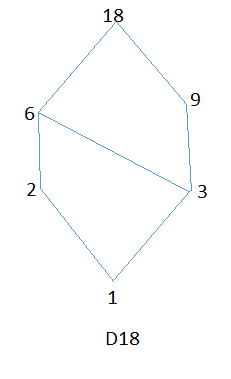
This is the Example of lattice which is Distributive Lattice but not Complemented Lattice.
In Distributive Lattice complement of element an element if exists is Unique i.e. each element has at most one complement.
and in Complemented Lattice each element has at least one complement.
This Example satisfy the condition of Distributive Lattice but fails the condition of Complemented Lattice because element 6 have no complement.
2. No, it is not True.Distributive Lattice might be bounded but Complemented should be bounded.
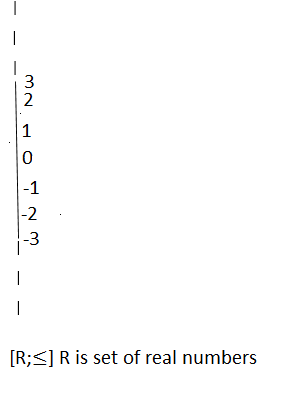
This is Unbounded Lattice and distributive too because here every element has at most one complement.it is not complemented Lattice because first, it is unbounded and second Here complement of every element is not present.
One alternate way to check Distributive Lattice is If
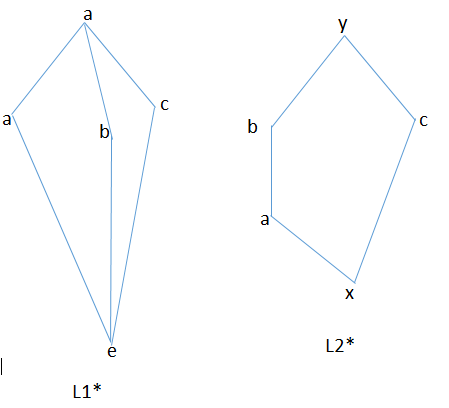
Here L 1 * and L 2* is not distributive because
L 1 *= a∨(b∧c) =(a∨b)∧(a∨c) L 2*=a∨(b∧c) =(a∨b)∧(a∨c)
(a∨x) = (y∧y) (a∨x) = (b∧y)
a≠y a≠b
if Lattice contains a sub lattice which is isomorphic to one of these two then we can say Lattice is not distributive and otherwise it is distributive.it doesn't matter Lattice bounded or not.There is no relation between Bounded Lattice and Distributive Lattice.

