• edited by
23,871 views
54 54 votes

Consider three $4$-variable functions $f_1, f_2$, and $f_3$, which are expressed in sum-of-minterms as

$f_1=\Sigma(0,2,5,8,14),$

$f_2=\Sigma(2,3,6,8,14,15),$

$f_3=\Sigma (2,7,11,14)$

For the following circuit with one AND gate and one XOR gate the output function $f$ can be expressed as:

  1. $\Sigma(7,8,11)$
  2. $\Sigma (2,7,8,11,14)$
  3. $\Sigma (2,14)$
  4. $\Sigma (0,2,3,5,6,7,8,11,14,15)$

8 Answers

Best answer
79 79 votes
Perform $f_1 \cdot f_2$ first, then with the result perform $XOR$ with $f_3$.

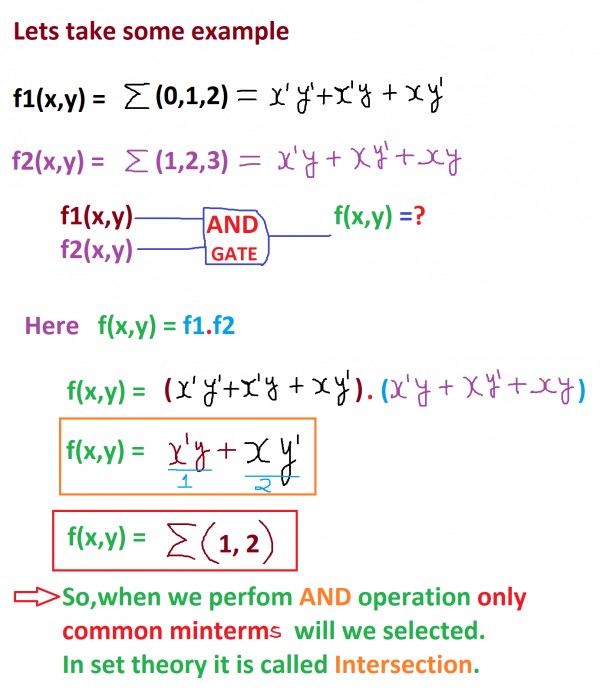
$f1 \cdot f2$ means just take common minterms in $f_1$ and $f_2$ (WHY? due to AND gate present, the minterm should be present in both functions.)

$f_1.f_2 = \Sigma (0,2,5,8,14) \cdot  \Sigma (2,3,6,8,14,15) = \Sigma (2,8,14)$

$\Sigma (2,8,14) \oplus  \Sigma (2,7,11,14) = \Sigma (7,8,11)$
• selected by
21 21 votes

Option:A


$(f1.f2)\bigoplus f3$

$(f1.f2)'.f3+(f1.f2).f3'$

$(2,8,14)'.(2,7,11,14)+(2,8,14).(2,7,11,14)'$

$(0,1,3,4,5,6,7,9,10,11,12,13,15).(2,7,11,14)+(2,8,14).(0,1,3,4,5,6,8,9,10,12,13,15)$

$(7,11)+(8)$

$(7,8,11)$

18 18 votes

From the  given diagram we can write like

$f=(f_{1}.f_{2})\oplus f_{3}$

We know that $A\oplus B=A\overline{B}+\overline{A}B$

So ,we can expend it and get

$f=(f_{1}.f_{2}).\overline{f_{3}}+\overline{(f_{1}.f_{2})}.f_{3}$

Apply De-Morgan's  laws

$\overline{(A.B)}=\overline{A}+\overline{B}$

$\overline{(A+B)}=\overline{A}.\overline{B}$

Now $f=(f_{1}.f_{2}).\overline{f_{3}}+\overline{(f_{1}}+\overline{f_{2})}.f_{3}$

             Apply distributive rule

$f=(f_{1}.f_{2}).\overline{f_{3}}+\overline{f_{1}}.f_{3}+\overline{f_{2}}.f_{3}$  -------------$>(1)$

Given that

$f_1=\Sigma(0,2,5,8,14)$

$\overline{f_{1}}=\Sigma(1,3,4,6,7,9,10,11,12,13,15)$

$f_2=\Sigma(2,3,6,8,14,15)$

$\overline{f_{2}}=\Sigma(0,1,4,5,7,9,10,11,12,13)$

$f_3=\Sigma (2,7,11,14)$

$\overline{f_{3}}=\Sigma(0,1,3,4,5,6,8,9,10,12,13,15)$

Now 

$f_{1}.f_{2}=\Sigma(0,2,5,8,14).\Sigma(2,3,6,8,14,15)$

Perform Intersection and get it

$f_{1}.f_{2}=\Sigma(2,8,14)$

$(f_{1}.f_{2}).\overline{f_{3}}=\Sigma(2,8,14).\Sigma(0,1,3,4,5,6,8,9,10,12,13,15)$

Perform Intersection and get it

$(f_{1}.f_{2}).\overline{f_{3}}=\Sigma(8)$

and $\overline{f_{1}}.f_{3}=\Sigma(1,3,4,6,7,9,10,11,12,13,15).\Sigma (2,7,11,14)$

      Perform Intersection and get it

      $\overline{f_{1}}.f_{3}=\Sigma(7,11)$

and last one 

$\overline{f_{2}}.f_{3}=\Sigma(0,1,4,5,7,9,10,11,12,13).\Sigma (2,7,11,14)$

 Perform Intersection and get it

$\overline{f_{2}}.f_{3}=\Sigma(7,11)$

Now put the values in the equation $(1)$ and get

$f=(f_{1}.f_{2}).\overline{f_{3}}+\overline{f_{1}}.f_{3}+\overline{f_{2}}.f_{3}$

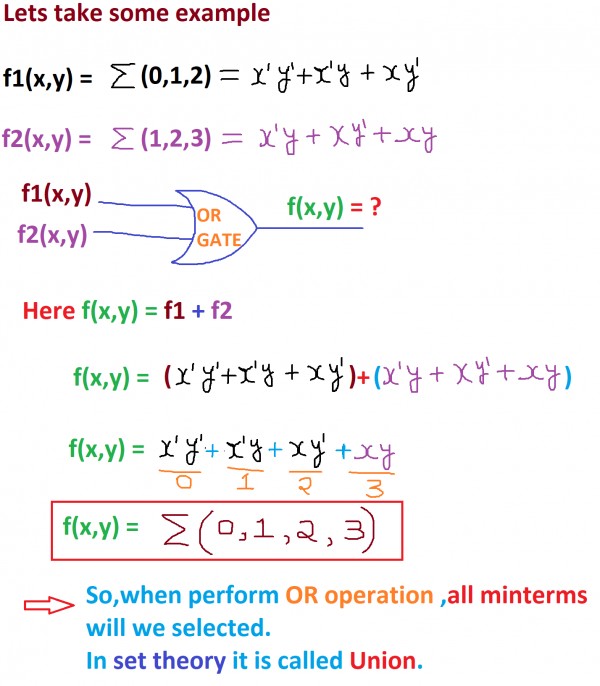
$f=\Sigma(8)+\Sigma(7,11)+\Sigma(7,11)$

Perform Union and get it

$f=\Sigma(7,8,11)$

---------------------------------------------------------------------------------------------------------

This is better way to analyze,how GATE works.
• edited by
12 12 votes
f1 and f2 = ∑(0,2,5,8,14) and ∑(2,3,6,8,14,15) = ∑(2,8,14)  (common minterms)
(f1 and f2) xor f3 = ∑(2,8,14) xor ∑(2,7,11,14)
we know a ⊕ b = a'b + ab', so
∑(2,8,14) xor ∑(2,7,11,14)
= (∑(0,1,3,4,5,6,7,9,10,11,12,13,15) and ∑(2,7,11,14))  or  (∑(2,8,14) and ∑(0,1,3,4,5,6,8,9,10,12,13,15))
= ∑(7,11) or ∑(8)
= ∑(7,8,11)   (union)
1 1 vote
f1*f2 = ∑(2,8,14)
f3 = ∑(2,7,11,14)
f1*f2 ⊕ f3 = ∑(2,8,14) ⊕ ∑(2,7,11,14)
= ∑(8,7,11) (Note: Choose the terms which are not common)
Answer:
Position:
Show:

Related questions

79 79 votes
13 answers 13 answers
52.1k
52.1k views
Arjun asked Feb 7, 2019
52,082 views
What is the minimum number of $2$-input NOR gates required to implement a $4$ -variable function expressed in sum-of-minterms form as $f=\Sigma(0,2,5,7, 8, 10, 13, 15)?$ ...
24 24 votes
2 answers 2 answers
4.9k
4.9k views
go_editor asked Dec 11, 2016
4,855 views
Three switching functions $f_1, \: f_2 \:$ and $f_3$ are expressed below as sum of minterms.$f_1 (w, x, y, z) = \sum \: 0, 1, 2, 3, 5, 12$$f_2 (w, x, y, z) = \sum \: 0, 1...
32 32 votes
4 4 answers
15.0k
15.0k views
Arjun asked Feb 16, 2024
14,996 views
Consider $4$-variable functions $f 1, f 2, f 3, f 4$ expressed in sum-of-minterms form as given below.$$\begin{array}{l}f 1=\sum(0,2,3,5,7,8,11,13) \\f 2=\sum(1,3,5,7,11,...