• edited by
21,421 views
79 79 votes

Consider the undirected graph $G$ defined as follows. The vertices of $G$ are bit strings of length $n$. We have an edge between vertex $u$ and vertex $v$ if and only if $u$ and $v$ differ in exactly one bit position (in other words, $v$ can be obtained from $u$ by flipping a single bit). The ratio of the chromatic number of $G$ to the diameter of $G$ is,

  1. $\frac{1}{\left(2^{n-1}\right)}$
  2. $\left(\frac{1}{n}\right)$
  3. $\left(\frac{2}{n}\right)$
  4. $\left(\frac{3}{n}\right)$

9 Answers

Best answer
65 65 votes

Answer is (C)

For the given condition we can simply design a K-MAP and mark an edge between every two adjacent cells in K-Map. (adjacency has to seen just as we do for minimization )

That will give us a Bipartite graph. chromatic number for this $=2$.

Also from the same we can conclude that we need ,for a $'n'$ bit string, to traverse NO MORE than $\left(n-1\right)$ edges or $'n'$ vertices to get a path b/w two arbitrary points.

So ratio is $\left(\frac{2}{n}\right).$

The given graph is actually hypercubegraph. 

https://en.wikipedia.org/wiki/Hypercube_graph

See problem 4 here:
http://ocw.mit.edu/courses/electrical-engineering-and-computer-science/6-042j-mathematics-for-computer-science-spring-2005/assignments/pset5_soln.pdf

• edited by
46 46 votes

Eccentricity is we have to traverse max distance using optimal path (i.e by using min vetrices)

Max. Eccentricity (i.e Diameter) here is 3, as we can start from any vertex say (000) and to reach vertex (111) diameter is 3.

Hence, the ratio 2/n.

n is here 3 i.e length of bit string


9 9 votes
(ans c)

It can be easily solved by putting the value of n=1.

I.e, we have to node '0' and '1'. And they are connected with an edge. Here C.N. is 2 and diameter is 1. So ratio is 2.

Now put n=1 in option and check whether answer is 2 or not.
6 6 votes

Simpler Way:-

Lets take $n = 2$. So we have $2^2 = 4$ bit strings = ${00,01,10,11}$

Now it’s given “We have an edge between vertex $u$ and vertex $v$ if and only if $u$ and $v$ differ in exactly one bit position (in other words, $v$ can be obtained from $u$ by flipping a single bit)”. So here will be edge from $00$ to $01$, $00$ to $10$, $01$ to $11$ and $11$ to $10$. So the Graph will look like this:-
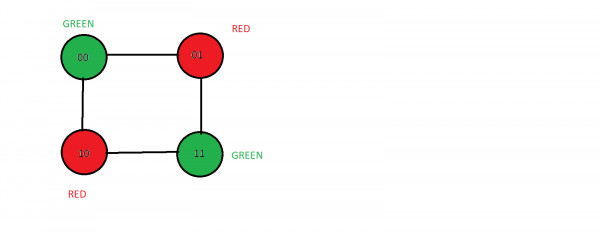
We can see that only 2 colours are enough to colour it. Hence Chromatic number of this graph is $2$.

Now, if we try to find the diameter of the graph {max(smallest distance between any pair of vertices)}. We get the diameter also as $2$. 

Thus, the ratio of the chromatic number of $G$ to the diameter of $G$ is = $2/2 = 1$.

Looking at the options only Option C is TRUE.

1 1 vote
answer would be 2/n as it would be hypercube and its chromatic number would be 2 and diameter that is max distance between two vertices would be n
Answer:
Position:
Show:

Related questions

49 49 votes
8 answers 8 answers
14.2k
14.2k views
Ishrat Jahan asked Oct 31, 2014
14,227 views
If all the edge weights of an undirected graph are positive, then any subset of edges that connects all the vertices and has minimum total weight is aHamiltonian cyclegri...
60 60 votes
6 answers 6 answers
26.5k
26.5k views
Akash Kanase asked Feb 12, 2016
26,516 views
The minimum number of colours that is sufficient to vertex-colour any planar graph is ________.
62 62 votes
6 answers 6 answers
18.1k
18.1k views
Kathleen asked Sep 15, 2014
18,099 views
The minimum number of colours required to colour the vertices of a cycle with $n$ nodes in such a way that no two adjacent nodes have the same colour is$2$$3$$4$$n-2 \lef...
64 64 votes
11 answers 11 answers
24.9k
24.9k views
gatecse asked Sep 15, 2014
24,948 views
What is the chromatic number of an $n$ vertex simple connected graph which does not contain any odd length cycle? Assume $n 2$.$2$$3$$n-1$ $n$