1,785 views

2 Answers

1 1 vote

Yes, True. The set $D_n$ of all positive integer divisors of a fixed integer $n$, ordered by divisibility, is a distributive lattice.

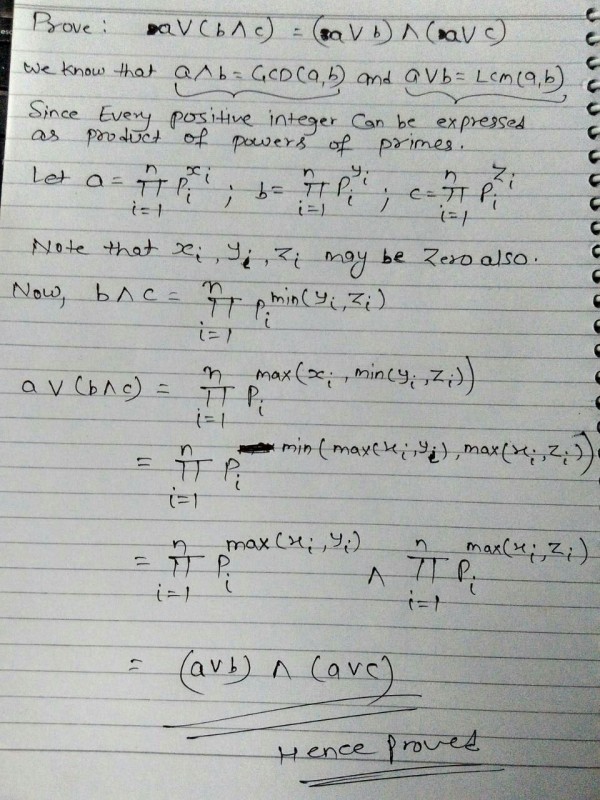
If You seek a Formal Proof, Here it goes :

We already know that "The set $(D_n,/)$ is a  lattice." (also Can be proved easily)

So, In Order to Prove it Distributive, We need to Prove either one of the Two Distributive rules (Because If One holds then Other also Holds)

So, We need to Prove that $a \vee (b \wedge  c) = (a \vee b) \wedge (a \vee c)$
Position:
Show:

Related questions

0 0 votes
1 1 answer
2.3k
2.3k views
dan31 asked Nov 8, 2018
2,323 views
A relation R on a set of positive integers is defined by (a,b) belongs to R iff a and b are relatively prime.Which of the following is true about R?a. Symmetric and Refle...
0 0 votes
1 answers 1 answer
2.3k
2.3k views
srestha asked May 15, 2018
2,349 views
How to distinguish between countably finite , countably infinite , uncountably infinite set?for reference see this ques:https://gateoverflow.in/36654/why-set-of-all-funct...
2 2 votes
1 1 answer
1.2k
1.2k views
ashish pal asked Dec 31, 2017
1,154 views
Let $f: A \to B$ be a function and $S$ and $T$ be subsets of $B$. Consider the following statements about image (range) :$S1:\quad f^{-1}(S \cup T) = f^{-1}(S) \cup f^{-1...
2 2 votes
1 1 answer
1.1k
1.1k views
ram_18051996 asked Jun 15, 2017
1,123 views
{ a } ∈ A buta ∉ Awhy ?here ' a is the element of set {a} ' ,and ' set {a} is the element of A" , so " a also element of A " . please clear my doubt .