edited by
28,084 views
91 91 votes
Consider Guwahati, $(G)$ and Delhi $(D)$ whose temperatures can be classified as high $(H)$, medium $(M)$ and low $(L)$. Let $P(H_G)$ denote the probability that Guwahati has high temperature. Similarly, $P(M_G)$ and $P(L_G)$ denotes the probability of Guwahati having medium and low temperatures respectively. Similarly, we use $P(H_D),\:  P(M_D)$ and $P(L_D)$ for Delhi. The following table gives the conditional probabilities for Delhi’s temperature given Guwahati’s temperature.

$$
\begin{array}{|c|c|c|c|}
\hline
 & H_D & M_D & L_D \\
\hline
H_G & 0.40 & 0.48 & 0.12 \\
\hline
M_G & 0.10 & 0.65 & 0.25 \\
\hline
L_G & 0.01 & 0.50 & 0.49 \\
\hline
\end{array}
$$

Consider the first row in the table above. The first entry denotes that if Guwahati has high temperature $(H_G)$ then the probability of Delhi also having a high temperature $(H_D)$ is $0.40;$ i.e., $P(H_D \mid H_G) = 0.40$. Similarly, the next two entries are $P(M_D \mid H_G) = 0.48 \text{ and } P(L_D \mid H_G) = 0.12$. Similarly for the other rows.

If it is known that $P(H_G) = 0.2, \: P(M_G) = 0.5$, and $P(L_G)=0.3$, then the probability (correct to two decimal places) that Guwahati has high temperature given that Delhi has high temperature is ________.

6 Answers

Best answer
96 96 votes

$P\left(H_G\mid H_D\right) = \frac{P(H_G \wedge H_D)}{P(H_D)} = P\left(H_D\mid H_G\right) \times \frac{P(H_G)}{P(H_D)}$

$=0.40 \times 0.2 \times\frac{1}{P(H_D)}$.

$P(H_D) = P\left(H_D \mid H_G\right) .P(H_G)+ P\left(H_D \mid M_G\right).P(M_G)+ P\left(H_D \mid L_G\right).P(L_G) $

$=0.4\times0.2+0.1\times0.5+0.01\times0.3 = 0.133$

$\therefore P\left(H_G\mid H_D\right)$ $\\= 0.40 \times 0.2 \times\frac{1}{P(H_D)} \\=\frac{0.08}{  0.133}\\=0.6015$

Ref: https://en.wikipedia.org/wiki/Bayes%27_theorem

selected by
136 136 votes

A Bayes theorem question which can be solved easily using the tree diagram.
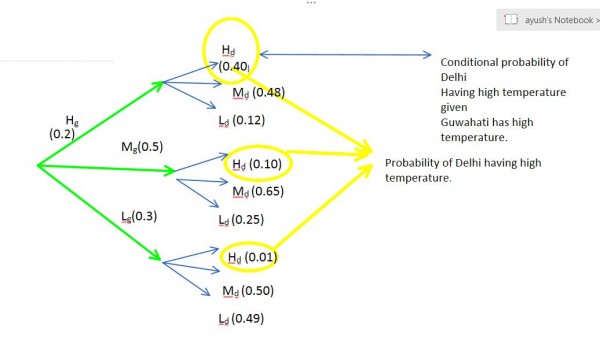
Conditional probabilities given in question are represented above in the tree diagram.

The green edges indicate the probability of Guwahati having high, medium or low temperatures.

The blue edges after each yellow edge show the probability of having high, medium or low temperature in Delhi provided, a high, medium or low temperature in Guwahati.

It is asked

probability (correct to two decimal places) that Guwahati has high temperature given that Delhi has high temperature 

which is given by

P(HG | HD) = $\frac{P(H_{G} \cap H_{D})}{P(H_{D})}$

P(HG$\cap$HD) = probability that Delhi has high temperature and Guwahati has high temperature = 0.2*0.4 = 0.08

P(HD) = Probability that Delhi has high temperature is given by a taken sum of all high-temperature cases in Delhi, regardless of what temperature in Guwahati is(High, Medium or low). i.e. Take the sum of all such conditional probabilities. Marked by yellow bubbles in the diagram.

P(HD) = (0.2*0.4) + (0.5*0.10) + (0.3*0.01) = 0.133

So, P(HG | HD) = $\frac{0.08}{0.133} = 0.601$

Answer:
Position:
Show:

Related questions

46 46 votes
4 answers 4 answers
13.2k
13.2k views
Arjun asked Feb 18, 2021
13,209 views
A sender $(\textsf{S})$ transmits a signal, which can be one of the two kinds: $H$ and $L$ with probabilities $0.1$ and $0.9$ respectively, to a receiver $(\textsf{R})$.I...
4 4 votes
1 1 answer
644
644 views
Shubham Sharma 2 asked Jun 16, 2025
644 views
There are two bags, one with $10$ red balls and $90$ blue balls, and another with $90$ red balls and $10$ blue balls. You pick one of the two bags uniformly at random and...
5 5 votes
3 3 answers
434
434 views
Shubham Sharma 2 asked Jun 20, 2025
434 views
Rohit Sharma is facing Shardul Thakur's bowling in the IPL. $40 \%$ of Shardul's deliveries to Rohit are good length balls, $40 \%$ are short pitched, and $20 \%$ are ove...
32 32 votes
2 answers 2 answers
9.6k
9.6k views
gatecse asked Sep 29, 2014
9,567 views
An automobile plant contracted to buy shock absorbers from two suppliers $ X$ and $ Y$ . $ X$ supplies $60\%$ and Y supplies $40\%$ of the shock absorbers. All shock abso...