Euler’s Theorem
If $m$ is a positive integer and $a$ is an integer such that $(a,m)=1$ then
$a^{ϕ(m)}≡1(mod m)$ where $ϕ(m)$ Euler's totient function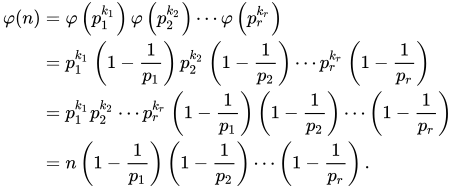
Note for example $2^{ϕ(9)}=2^{6}=64≡1(mod 9)$.
So statement 1 is Euler’s Theorem so s1 is coreect.
Fermat's little theorem
states that if $ p $ is a prime number, then for any intezer. $a$, the number $a^{p}-a$ is an integer multiple of $ p$. In the notation of modular arithmetic, this is expressed as


For example, if $ a = 2$ and $p = 7$, then $2^{7} = 128$, and $128 − 2 = 126 = 7 × 18$ is an integer multiple of $ 7$.
So statement 2 is not Fermat's little theorem S2 is false
Option A
