edited by
10,070 views
6 6 votes

Which of the following is principal conjunctive normal form for $[(p\vee q)\wedge\ \neg p \rightarrow \neg q ]$ ?

  1. $p\ \vee \neg q$
  2. $p \vee q $
  3. $\neg p \vee q$
  4. $\neg p\ \vee  \neg q$  

2 Answers

7 7 votes

Conjunctive Normal Form of a given well formed formulae (wff) is an equivalent wff consisting of product of elementary sum terms.

Principal Conjunctive Normal Form of a given wff is an equivalent wff consisting of product of sums where each sum term consists of all variables used in the formulae in negated or non-negated form.
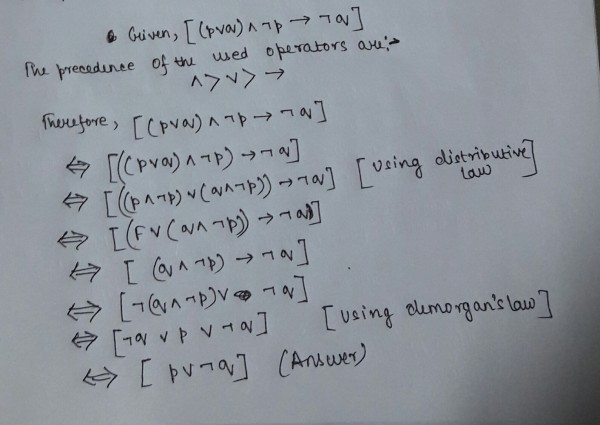


Here, one question may arise:

HOW THE REDUCED WFF IS IN PRINCIPAL CNF FORM?

ANSWER: 

In principal conjunctive normal form, every sum term must contain every variable, used in the given formulae, in negated or non-negated form. 

PRINCIPAL CNF FORM  ⟺ CANONICAL PRODUCT OF SUM FORM

Here in reduced formulae of the given question, there is only one sum term, which is:   p∨⏋q 

This sum term contains all variables used in the original wff ( p and q ) in negated or non-negated form i.e. p is in non-negated form and q is in negated form. 

This satisfies the condition of principal conjunctive normal form and hence the reduced wff is in PRINCIPAL CONJUNCTIVE NORMAL FORM.


Thus, answer is OPTION 1.

edited by
2 2 votes
Precedence in propositional logic:  $\neg >\wedge> \vee> \rightarrow> \leftrightarrow$

$[(p \vee q)\wedge\ \neg p \rightarrow \neg q]$

$\implies [((p \vee q)\wedge\ \neg p) \rightarrow \neg q]$

$\implies [((p \wedge\ \neg p)\vee (q \wedge\ \neg p)) \rightarrow \neg q]$ (using distributive law)

$\implies [(0\vee (q \wedge\ \neg p)) \rightarrow \neg q]$

$\implies [(q \wedge\ \neg p) \rightarrow \neg q]$

$\implies [\neg (q \wedge\ \neg p) \vee \neg q]$  (using demorgan's law)

$\implies [\neg q \vee p \vee \neg q]$

$\implies [p \vee \neg q]$

$\therefore$ Option $1.$ is correct.
Answer:
Position:
Show:

Related questions

6 6 votes
3 3 answers
2.9k
2.9k views
Arjun asked Jul 2, 2019
2,934 views
Match List-I with List-II:$$\begin{array}{|c|c|c|c|} \hline {} & \text{List-I} & {} & \text{List-II} \\ \hline (a) & p \rightarrow q & (i) & \rceil ( q \rightarrow \rcei...
10 10 votes
3 answers 3 answers
9.5k
9.5k views
Arjun asked Jul 2, 2019
9,453 views
Consider the poset $( \{3,5,9,15,24,45 \}, \mid).$Which of the following is correct for the given poset ?There exist a greatest element and a least elementThere exist a ...
2 2 votes
2 2 answers
10.3k
10.3k views
Arjun asked Jul 2, 2019
10,291 views
How many ways are there to place $8$ indistinguishable balls into four distinguishable bins?$70$$165$$^8C_4$$^8P_4$
4 4 votes
2 2 answers
7.7k
7.7k views
Arjun asked Jul 2, 2019
7,676 views
How many bit strings of length ten either start with a $1$ bit or end with two bits $00$ ?$320$$480$$640$$768$