232 views
6 6 votes

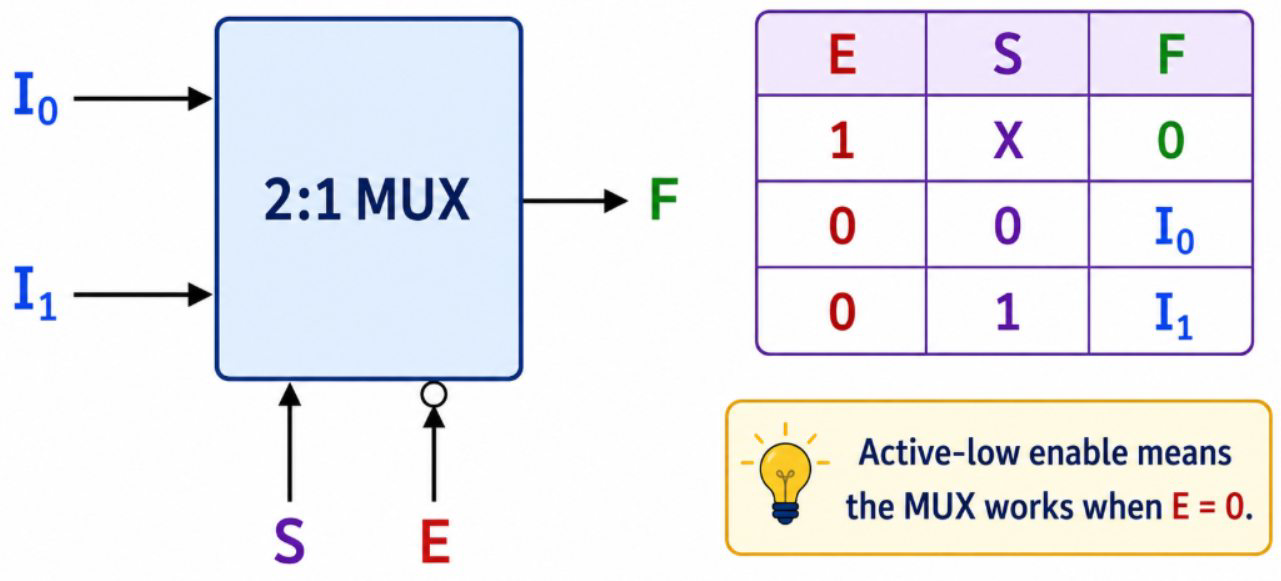
A $2:1$ MUX has inputs $\mathrm{I}_0,\mathrm{I}_1$, select line $\mathrm{S}$, and active-low enable input $\mathrm{E}$. When $\mathrm{E}=1$, the output is $0$. When $\mathrm{E}=0$, the MUX works normally. Which expression represents the output $\mathrm{F}$?

  1. $\mathrm{F}=\mathrm{E}(\mathrm{S}'\mathrm{I}_0+\mathrm{S}\mathrm{I}_1)$
     
  2. $\mathrm{F}=\mathrm{E}'+\mathrm{S}'\mathrm{I}_0+\mathrm{S}\mathrm{I}_1$
     
  3. $\mathrm{F}=\mathrm{E}'(\mathrm{S}'\mathrm{I}_0+\mathrm{S}\mathrm{I}_1)$
     
  4. $\mathrm{F}=\mathrm{S}'\mathrm{I}_0+\mathrm{S}\mathrm{I}_1$

2 Answers

2 2 votes

For a normal $2:1$ MUX,

$\mathrm{F}=\mathrm{S}'\mathrm{I}_0+\mathrm{S}\mathrm{I}_1$.

But here enable is active-low.

That means the MUX works only when $\mathrm{E}=0$.

So, the working condition is represented by $\mathrm{E}'$.

Therefore, the output becomes:

$\mathrm{F}=\mathrm{E}'(\mathrm{S}'\mathrm{I}_0+\mathrm{S}\mathrm{I}_1)$.

When $\mathrm{E}=1$, $\mathrm{E}'=0$, so $\mathrm{F}=0$.

When $\mathrm{E}=0$, $\mathrm{E}'=1$, so the MUX works normally.

Answer: C

edited by
Answer:
Position:
Show:

Related questions

3 3 votes
2 2 answers
209
209 views
2 2 votes
1 1 answer
185
185 views
GO Classes asked Jun 17
185 views
A $4:2$ priority encoder has active-high inputs $\mathrm{D}_0,\mathrm{D}_1,\mathrm{D}_2,\mathrm{D}_3$, where $\mathrm{D}_3$ has the highest priority and $\mathrm{D}_0$ ha...
6 6 votes
2 2 answers
202
202 views
GO Classes asked Jun 17
202 views
For a $4:2$ binary encoder with active-high inputs $\mathrm{I}_0,\mathrm{I}_1,\mathrm{I}_2,\mathrm{I}_3$ and outputs $\mathrm{Y}_1,\mathrm{Y}_0$, assume exactly one input...
4 4 votes
2 2 answers
171
171 views
GO Classes asked Jun 17
171 views
A $1:4$ DEMUX has data input $\mathrm{D}$ and select lines $\mathrm{S}_1,\mathrm{S}_0$. Which of the following output equations is correct?$\mathrm{Y}_0=\mathrm{S}_1\math...