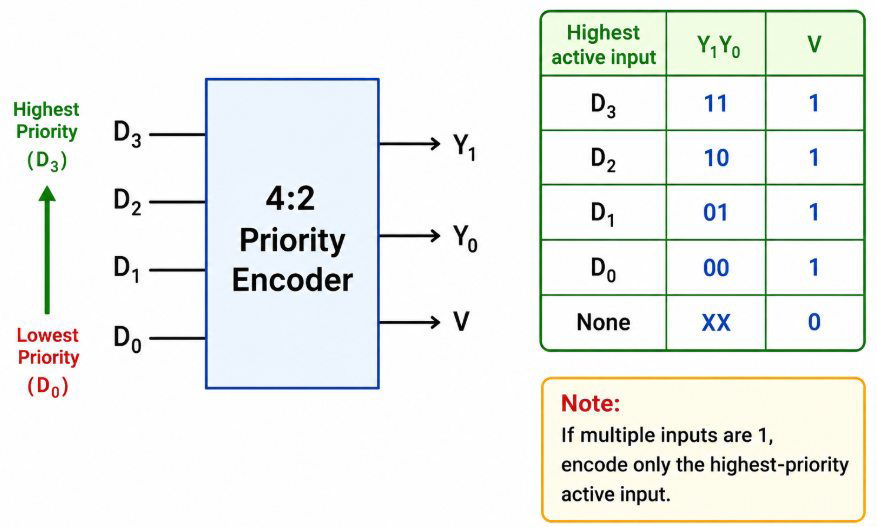
In a priority encoder, if more than one input is $1$, the highest priority input is encoded.
Priority order is:
$\mathrm{D}_3>\mathrm{D}_2>\mathrm{D}_1>\mathrm{D}_0$.
Now check $\mathrm{Y}_1$.
The output code is $10$ when $\mathrm{D}_2$ is the highest active input.
The output code is $11$ when $\mathrm{D}_3$ is active.
So, $\mathrm{Y}_1=1$ whenever $\mathrm{D}_2=1$ or $\mathrm{D}_3=1$.
$\boxed{\therefore \mathrm{Y}_1=\mathrm{D}_2+\mathrm{D}_3}$
Now check $\mathrm{Y}_0$.
$\mathrm{Y}_0=1$ when $\mathrm{D}_3=1$.
Also, $\mathrm{Y}_0=1$ when $\mathrm{D}_1=1$ and no higher input $\mathrm{D}_2$ is active.
$\boxed{\therefore \mathrm{Y}_0=\mathrm{D}_3+\mathrm{D}_2'\mathrm{D}_1}$
Valid output $\mathrm{V}$ is $1$ if at least one input is active.
$\boxed{\therefore \mathrm{V}=\mathrm{D}_0+\mathrm{D}_1+\mathrm{D}_2+\mathrm{D}_3}$
Answer: C
