• retagged by
736 views

1 Answer

Best answer
6 6 votes

Matching number of a graph is defined as the maximum number of non-adjacent edges in a graph.
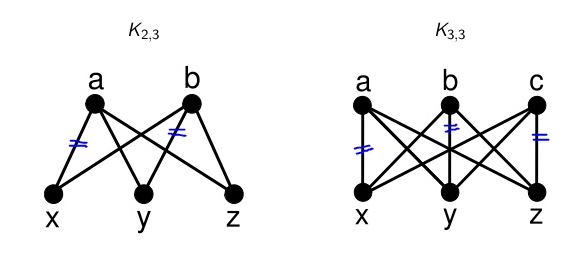
(I have marked one maximum-possible set of non-adjacent edges, but other set is also possible)

In a complete bipartite graph $K_{m,n}$ $m$ nodes are adjacent to each of the $n$ nodes and $n$ nodes are adjacent to each of $m$ nodes. (basic definition of bipartite graph)

So, If an edge is to be included in counting of Matching number, then all adjacent edges cannot be included. 

So, Matching Number in $K_{2,3} = 2$ and in $K_{3,3} = 3$

Although there may exist a much formal proof, but by taking few more examples it can be said that Matching Number for $\color{maroon}{K_{m,n} = \;min(m,n)}$

• selected by
Position:
Show:

Related questions

0 0 votes
1 answers 1 answer
1.0k
1.0k views
atul_21 asked Dec 21, 2017
1,037 views
I am not convinced by this. Please explain or please tell me the source from where I can clear this out.
5 5 votes
1 answers 1 answer
3.7k
3.7k views
7 7 votes
3 3 answers
1.6k
1.6k views
learncp asked Jan 26, 2016
1,609 views
Find the matching number for the given graph-
7 7 votes
2 2 answers
3.2k
3.2k views
shikharV asked Jan 18, 2016
3,151 views
Given explanation:In the above explanation, it is written that matching number is 4 but I am getting matching number as 3 for this graph(choosing edges 1-2, 3-4 and 6-7)....