• edited by
32,270 views
82 82 votes

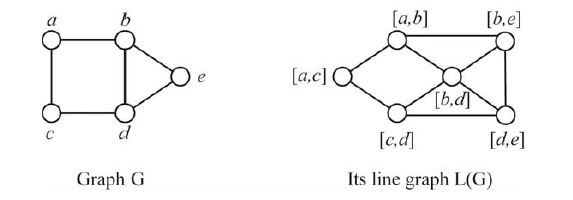
The line graph $L(G)$ of a simple graph $G$ is defined as follows:

  • There is exactly one vertex $v(e)$ in $L(G)$ for each edge $e$ in $G$.
  • For any two edges $e$ and $e'$ in $G$, $L(G)$ has an edge between $v(e)$ and $v(e')$, if and only if $e$ and $e'$ are incident with the same vertex in $G$.

Which of the following statements is/are TRUE?

  • (P) The line graph of a cycle is a cycle.
  • (Q) The line graph of a clique is a clique.
  • (R) The line graph of a planar graph is planar.
  • (S) The line graph of a tree is a tree.
     
  1. $P$ only
  2. $P$ and $R$ only
  3. $R$ only
  4. $P, Q$ and $S$ only

10 Answers

Best answer
72 72 votes

P) True. Because every edge in cycle graph will become a vertex in new graph $L(G)$ and every vertex of cycle graph will become an edge in new graph.

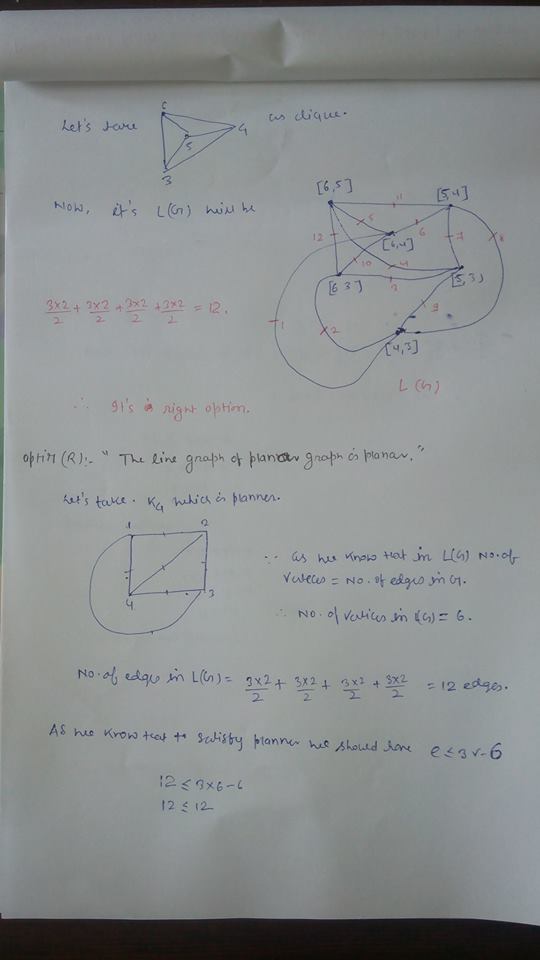
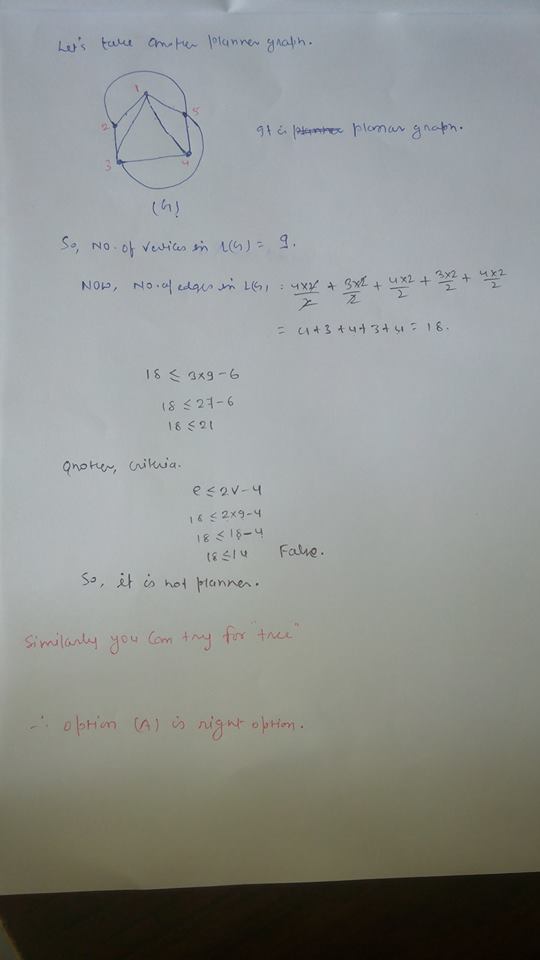
R) False. We can give counter example. Let $G$ has $5$ vertices and $9$ edges which is a planar graph. Assume degree of one vertex is $2$ and of all others are $4$. Now,  $L(G)$ has $9$ vertices (because $G$ has $9$ edges ) and $25$ edges. (See below). But for a graph to be planar $|E| <= 3|V| - 6$.

For $9$ vertices $|E| \leq 3*9 - 6$

$⇒|E| \leq 27 - 6$

$⇒|E| \leq 21$. But $L(G)$ has $25$ edges and so is not planar.

As R) is False option (B), (C) are eliminated.
http://www.personal.kent.edu/~rmuhamma/GraphTheory/MyGraphTheory/planarity.htm


S) False. By counter example. Try drawing a simple tree which has a Root node ,Root node has one child A, node A has two child B and C. Draw its Line graph acc. to given rules in question you will get a cycle graph of $3$ vertices.

So (D) also not correct.

$\therefore$  option (A) is correct.


For a graph G with n vertices and m edges, the number of vertices of the line graph L(G) is m, and the number of edges of L(G) is half the sum of the squares of the degrees of the vertices in G, minus m.

• edited by
32 32 votes

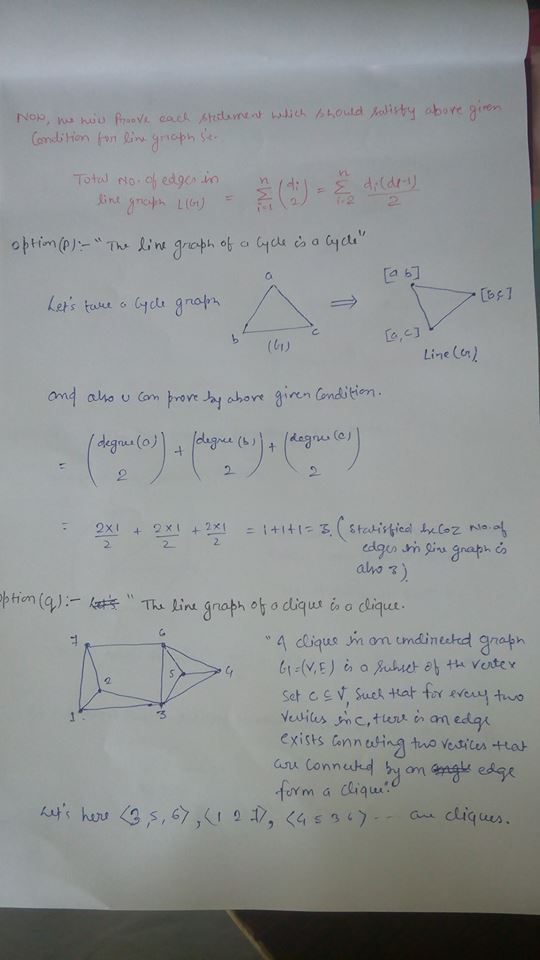
L(G) is a 2-set {e1,e2} of edges in G with which are adjacent to a common vertex v. This vertex v is uniquely determined by {e1,e2}. 

If a vertex vv has degree d, there are (d2) 2-sets{e1,e2} such that e1 and e2 are adjacent to v

So the total number of edges in L(G) is 

$\sum_{i=0}^{n}\binom{n}{2}=n(n-1)/2$

There is very simple and easy proof to drive expression for number of edges in lines graph- 
• edited by
20 20 votes

Answer is  option (A)

7 7 votes

Everything you need to know about LINE GRAPHS


You won’t find anything better than this anywhere as its from NPTEL IIT MADRAS.


2 2 votes

i think

(A) P only

because by taking a simple graph of 4 vertices(i.e planar graph)(take a 2 regular graph) and we can some to know it's planar    :    option C eliminated ,

but tree for tree is not possible as it seems to be a cycle : option D eliminated.

also planar doesn't seem possible ,

hence possible answer is option A.

Answer:
Position:
Show:

Related questions

34 34 votes
3 answers 3 answers
21.1k
21.1k views
Arjun asked Sep 24, 2014
21,111 views
Which of the following statements is/are TRUE for undirected graphs?P: Number of odd degree vertices is even.Q: Sum of degrees of all vertices is even. P only Q only Both...
3 3 votes
0 0 answers
6.9k
6.9k views
dd asked Nov 22, 2016
6,934 views
For which values of n are these graphs bipartite ?1. $K_n$2. $C_n$3. $W_n$4. $Q_n$
68 68 votes
8 answers 8 answers
17.3k
17.3k views
go_editor asked Apr 24, 2016
17,333 views
The $2^n$ vertices of a graph $G$ corresponds to all subsets of a set of size $n$, for $n \geq 6$. Two vertices of $G$ are adjacent if and only if the corresponding set...
55 55 votes
12 answers 12 answers
36.5k
36.5k views
Misbah Ghaya asked Feb 13, 2015
36,495 views
Let G be a connected planar graph with $10$ vertices. If the number of edges on each face is three, then the number of edges in G is_______________.