• recategorized by
2,481 views
2 2 votes

Consider the sets defined by the real solutions of the inequalities

$A = \{(x,y):x^2+y^4 \leq 1\} \:\:\:\:\:\:\: B=\{(x,y):x^4+y^6 \leq 1\}$ Then

  1. $B \subseteq A$
  2. $A \subseteq B$
  3. Each of the sets $A – B, \: B – A$ and $A \cap B$ is non-empty
  4. none of the above

1 Answer

4 4 votes

Here first both $|x|,|y|\leq 1$ as otherwise both A and B will have values greater than 1 hence would not satisfy the inequality.

Now, Let $(x,y)\in A$ then $x^2+y^4 \leq 1$

$\Rightarrow$ $x^4+y^6 = x^2 *x^2 +y^2*y^4 \leq 1^2 *x^2 +1^2*y^4 = x^2 + y^4 \leq 1$

$\Rightarrow$ $x^4+y^6 \leq 1$

Thus $(x,y)\in B$

Hence every point in A is also in B or $A \subseteq B$.

We can also prove the above by,

$x^4 \leq x^2$ since $|x|\leq 1$ , similarly $y^6\leq y^4$ as $|y|\leq 1$ ,

$\Rightarrow$ $x^4+y^6 \leq 1$.

Now since $x^4+y^6<x^2+y^4 \leq 1$ there exists a point $(x_1,y_1)$ such that $|x_1|,|y_1| \leq 1$

for which the value of  $x_1^4+y_1^6<1$

but $x_1^2+y_1^4>1$ ,

hence $B\not\subset A$ $\Rightarrow$ $B \neq A$.

This point $(x_1,y_1)$ must be along the boundaries as can be seen from the below image that as the value of the equations in A and B both increases value with increase in the value of $(x,y)$ due to even powers. 
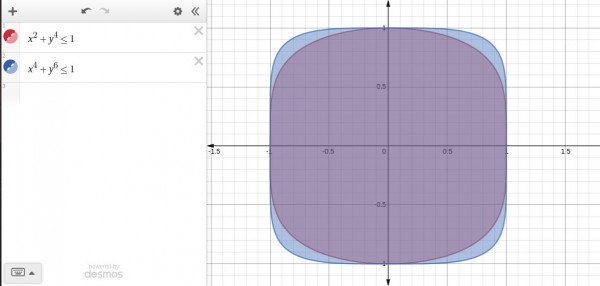


Thus the answer is Option (B)

• edited by
Position:
Show:

Related questions

3 3 votes
1 1 answer
1.1k
1.1k views
Arjun asked Sep 23, 2019
1,060 views
Let $\mathbb{N}=\{1,2,3, \dots\}$ be the set of natural numbers. For each $n \in \mathbb{N}$, define $A_n=\{(n+1)k, \: k \in \mathbb{N} \}$. Then $A_1 \cap A_2$ equals$A_...
1 1 vote
2 2 answers
1.7k
1.7k views
Arjun asked Sep 23, 2019
1,726 views
Let $A$ and $B$ be disjoint sets containing $m$ and $n$ elements respectively, and let $C=A \cup B$. Then the number of subsets $S$ (of $C$) which contains $p$ elements a...
2 2 votes
2 2 answers
1.1k
1.1k views
Arjun asked Sep 23, 2019
1,146 views
Let $(1+x)^n = C_0+C_1x+C_2x^2+ \dots + C_nx^n$, $n$ being a positive integer. The value of$$\left( 1+\dfrac{C_0}{C_1} \right) \left( 1+\dfrac{C_1}{C_2} \right) \cdots \l...
4 4 votes
1 1 answer
1.9k
1.9k views
Arjun asked Sep 23, 2019
1,857 views
Let $a_n=\bigg( 1 – \frac{1}{\sqrt{2}} \bigg) \cdots \bigg( 1 – \frac{1}{\sqrt{n+1}} \bigg), \: n \geq 1$. Then $\underset{n \to \infty}{\lim} a_n$equals $1$does not exi...