55,405 views
122 122 votes

A 4-bit carry look ahead adder, which adds two 4-bit numbers, is designed using AND, OR, NOT, NAND, NOR gates only. Assuming that all the inputs are available in both complemented and uncomplemented forms and the delay of each gate is one time unit, what is the overall propagation delay of the adder? Assume that the carry network has been implemented using two-level AND-OR logic.

  1. 4 time units
  2. 6 time units
  3. 10 time units
  4. 12 time units

23 Answers

Best answer
213 213 votes

It would take $6$ time units.

We know that:

$G_i = A_iB_i,$

$P_i = A_i\oplus B_i$ and 

$S_i = P_i\oplus C_i$

Also 

$C_1 = G_0 + P_0C_0$

$C_2 = G_1 + P_1G_0 + P_1P_0C_0$

$C_3 = G_2 + P_2G_1 + P_2P_1G_0 + P_2P_1P_0C_0$

$C_4 = G_3 + P_3G_2 + P_3P_2G_1 + P_3P_2P_1G_0 + P_3P_2P_1P_0C_0$

XOR can be implemented in 2 levels; level-1 ANDs and Level-2 OR. Hence it would take 2 time units to calculate $P_i$ and $S_i$

The 4-bit addition will be calculated in 3 stages

1. (2 time units) In 2 time units we can compute $G_i$ and $P_i$ in parallel. 2 time units for  $P_i$ since its an XOR operation and 1 time unit for $G_i$ since its an AND operation.

2. (2 time units) Once $G_i$ and $P_i$ are available, we can calculate the caries, $C_i$, in 2 time units.

Level-1 we compute all the conjunctions (AND). Example $P_3G_2, P_3P_2G_1, P_3P_2P_1G_0$ and $P_3P_2P_1P_0C_0$ which are required for $C_4$.

Level-2 we get the carries by computing the disjunction (OR).

3. (2 time units) Finally we compute the Sum in 2 time units, as its an XOR operation.

Hence, the total is 2 + 2 + 2 = 6 time units.

edited by
23 23 votes

To get Si  = Ai⊕Bi⊕Ci it requires two level AND-OR implementation

To generate Ci = function of (A0,B0,C0, A1,B1,C1, Ai-1,Bi-1, Ci-1) it also require two level AND-OR implementation.

so a total delay of 4 level, which is equivalent to 4 unit delay.

8 8 votes

In addition to the Best answer for this question , i am adding diagramatical representation for Ripple carry Adder for ease of understanding.

We know that:

Gi=AiBi,

Pi=Ai⊕Bi and 

Si=Pi⊕Ci

Also 

C1=G0+P0C0

C2=G1+P1G0+P1P0C0

C3=G2+P2G1+P2P1G0+P2P1P0C0

C4=G3+P3G2+P3P2G1+P3P2P1G0+P3P2P1P0C0

XOR can be implemented in 2 levels; level-1 ANDs and Level-2 OR.

Fig 1:
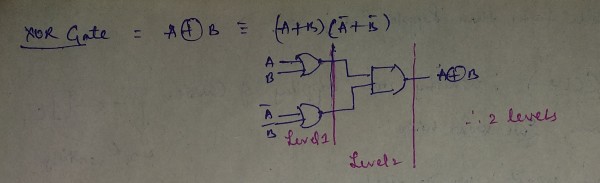
Hence it would take 2 time units to calculate Pi and Si

The 4-bit addition will be calculated in 3 stages:

Fig 2:
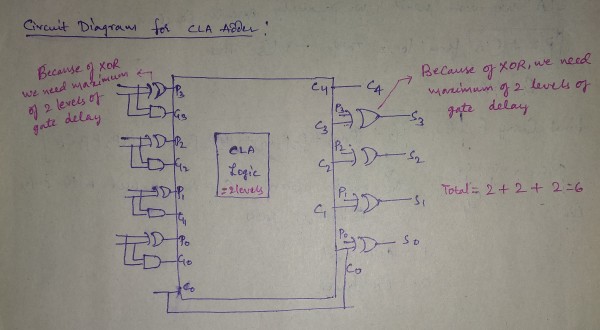
1. (2 time units) In 2 time units we can compute Gi and Pi in parallel. 2 time units for  Pi since its an XOR operation and 1 time unit for Gi since its an AND operation.(Refer Fig 2)

2. (2 time units) Once Gi and Pi are available, we can calculate the caries, Ci, in 2 time units.(Refer Fig 3)

Fig 3:
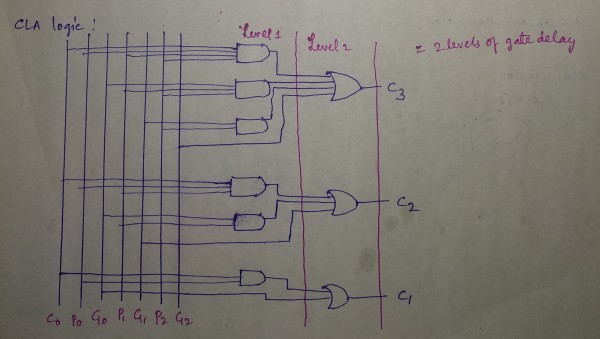
Level-1 we compute all the conjunctions (AND). Example P3G2,P3P2G1,P3P2P1G0P3G2,P3P2G1,P3P2P1G0 and P3P2P1P0C0P3P2P1P0C0 which are required for C4.

Level-2 we get the carries by computing the disjunction (OR).

3. (2 time units) Finally we compute the Sum in 2 time units, as its an XOR operation.(Refer Fig 2)

Hence, the total  propagation delay is 2 + 2 + 2 = 6 time units.

7 7 votes

The answer varies with the way we implement the gates. IF anyone has the official GATE key they must share it.
Answer is (b) 6 time units if we necessarily implement the Gi & Pi terms (which is no where mentioned in the question as mandatory).
Answer is (a) 4 time units if we write the carry terms directly and without separately implementing Gi & Pi terms

Heres the explanation of answer (a). Credits : GeeksForGeeks
https://www.geeksforgeeks.org/gate-gate-cs-2004-question-62/

Explanation: Let the input carry to the first adder be denoted by C1.

Now, to calculate C2 we need = P1C1 + G1 = 4 gate levels (P1 takes 2 gate levels)
to calculate S1 we need = P1 XOR C1 = 2 + 2 = 4 gate levels.

Since it is a Carry look ahead adder, computing C3 , S2 doesn’t have to wait for carry output C2 from the previous adder as C2, C3 etc will get computed at the same time.

Now,

S2 is computed as = P2 XOR C2 = P2.C2′ + P2′.C2
= P2 (P1.C1 + G1 )’ + P2′ (P1.C1 + G1) [ notice that we are not using the output carry from first adder C2 anywhere here ]
which can be implemented using 4 gate levels.

also C3 can be computed by using 4 gate levels and so on…
so the overall propagation delay is 4 gate level as the outputs at Si , Ci are available at the respective full adders after 4 gate levels = 4 time units.

To understand it with more clarity draw the carry look ahead adder circuit and then check it.

6 6 votes

answer is 4 time units.

Refer to http://faculty.kfupm.edu.sa/COE/abouh/Lesson3_3.pdf

5 5 votes
->Going by the given data:
    1. Circuit is designed using AND, OR, NOT, NAND, NOR gates only.
    2. All the "inputs" are available in both complemented and un-complemented forms.
    3. Carry network has been implemented using two-level AND-OR logic.
    
->We know, Gi = AiBi, Pi = Ai XOR Bi and Si = Pi XOR Ci
->Also C1 = G0 + P0C0
       C2 = G1 + P1G0 + P1P0C0
       C3 = G2 + P2G1 + P2P1G0 + P2P1P0C0
       C4 = G3 + P3G2 + P3P2G1 + P3P2P1G0 + P3P2P1P0C0
       
->XOR can be implemented in 2 levels; level-1 AND and Level-2 OR.
->The 4-bit addition will be calculated in 3 stages as follows:
    1. (2 time units) Compute Gi and Pi in parallel. 2 time units for  Pi since its an XOR operation and 1 time unit for Gi since its an AND operation.
    2. (2 time units) Compute caries i.e. Ci. Since it is given that, "Assume that the carry network has been implemented using two-level AND-OR logic."
    3. (3 time units) Finally we compute the sum. Sum being an XOR operation, would require 2 time units, but complemented inputs for sum are not available. Hence we use one level for getting complemented inputs for sum & 2 levels for AND-OR logic of sum, which amounts to 3 time units.
->Hence the total is 2 + 2 + 3 = 7 time units. But 7 is not in options.
->Instead of going by the definition of Pi as Ai XOR Bi, If we use Pi as Ai + Bi, we can save 1 time unit required for AND-OR operation of XOR. The time now required for stage 1 is reduced to 1 time unit.
->The total time required would be 1 + 2 + 3 = 6 time units which is option B.
Answer:
Position:
Show:

Related questions

55 55 votes
5 answers 5 answers
27.1k
27.1k views
Kathleen asked Sep 18, 2014
27,089 views
Consider the partial implementation of a $2-bit$ counter using $T$ flip-flops following the sequence $0-2-3-1-0,$ as shown below.To complete the circuit, the input $X$ sh...
39 39 votes
4 answers 4 answers
12.1k
12.1k views
Kathleen asked Sep 18, 2014
12,079 views
Consider a multiplexer with $X$ and $Y$ as data inputs and $Z$ the as the control input. $Z=0$ selects input $X$, and $Z=1$ selects input $Y$. What are the connections re...
44 44 votes
2 answers 2 answers
16.3k
16.3k views
Kathleen asked Sep 18, 2014
16,302 views
Which are the essential prime implicants of the following Boolean function?$f(a, b, c)= a' c+ ac'+b' c$$a' c$ and $ac'$$a' c$ and $b' c$$a' c$ only.$ac'$ and $bc'$
46 46 votes
5 answers 5 answers
19.4k
19.4k views
Kathleen asked Sep 18, 2014
19,369 views
A circuit outputs a digit in the form of $4$ bits. $0$ is represented by $0000, 1$ by $0001, \ldots, 9$ by $1001$. A combinational circuit is to be designed which takes t...